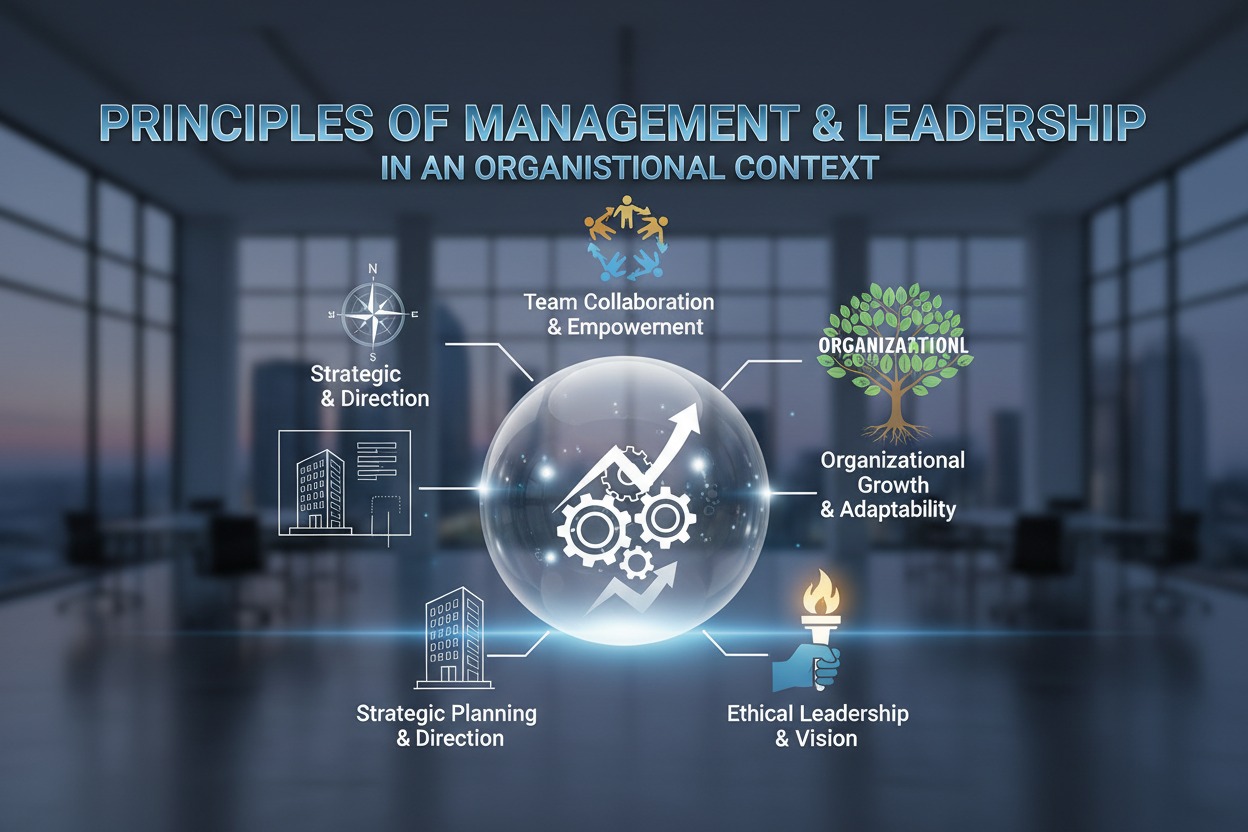
Effective organisational performance hinges on a profound understanding of management and leadership principles. This CMI 501 Assignment Example comprehensively examines the internal and external factors shaping an organisation’s operational landscape. It critically analyses the impact of legal status, mission and vision statements, and organisational structures on management roles. Furthermore, it investigates the intricate relationship between management and leadership theories, evaluating how diverse styles and cultural values influence individual and team performance. The analysis also covers essential knowledge, skills, and behaviours for effective management, alongside strategic approaches for fostering mutual trust and respect. By synthesising theoretical insights with practical applications, this assignment offers a robust framework for navigating organisational complexities and driving sustained success.
Task 1: The principles of management and leadership within an organisational context
LO1 Understand factors which impact on an organisation’s internal environment
AC 1.1: Examine the impact of legal status on the governance of an organisation
An organisation’s legal status fundamentally determines its governance structure, defining its operational framework and accountability to stakeholders. For instance, a private limited company (Ltd) operates as a separate legal entity, offering limited liability to shareholders. This necessitates a formal governance structure, typically a board of directors, responsible for strategic decision-making and Companies Act 2006 compliance. Directors owe fiduciary duties to the company, with their actions subject to shareholder and regulatory scrutiny. This framework ensures transparency and accountability, crucial for attracting investment and building external trust.
Conversely, public sector organisations, such as local authorities, operate under distinct legal and regulatory mandates. Their governance is often legislatively defined and subject to democratic oversight. Their primary objective is public service delivery, not profit maximisation, which significantly influences strategic priorities and decision-making. Public sector governance balances operational efficiency with public accountability and equitable resource distribution, often involving complex stakeholder engagement and high transparency. Non-profit organisations and charities introduce further governance complexity, governed by charity law and requiring demonstrated public benefit. Their governance structures, often including voluntary boards of trustees, ensure adherence to charitable purposes and ethical resource management. These diverse legal statuses underscore that the legal framework is a fundamental driver of organisational behaviour and governance.
Moreover, legal status influences an organisation’s capital-raising capacity and risk management. A public limited company (Plc) can raise substantial funds via public share issuance but faces stringent regulatory requirements and market pressure. In contrast, a sole trader or partnership offers greater operational flexibility but entails unlimited personal liability for business debts. This direct link between legal status and financial risk highlights the importance of selecting the appropriate legal form for strategic objectives. Ultimately, legal status profoundly impacts governance, shaping power dynamics, accountability mechanisms, and ethical standards that define organisational life.
AC 1.2: Analyse the purpose of an organisation’s mission and vision statements
Mission and vision statements are vital strategic tools that imbue an organisation with purpose, direction, and identity. A mission statement articulates the organisation’s fundamental reason for existence: what it does, whom it serves, and how it creates value. It acts as a guiding principle for daily operations, ensuring alignment with core purpose. For example, a mission focused on innovation and customer centricity will drive different behaviours than one prioritising cost leadership. By providing a clear statement of purpose, the mission unifies the workforce and communicates the organisation’s value proposition to external stakeholders.
In contrast, a vision statement paints a compelling picture of the organisation’s desired future, articulating its long-term aspirations. It inspires and motivates employees, encouraging them to contribute to a broader strategic ambition. A well-crafted vision can catalyse change, providing urgency and direction during transitions. For instance, a vision to lead in sustainable technology drives innovation and strategic investment. Together, mission and vision statements form the strategic framework for developing organisational goals and objectives.
These statements are also crucial for building organisational culture and identity, providing shared language and values that define internal practices. When employees connect with the mission and vision, they are more engaged and motivated. This shared purpose is especially important in large, complex organisations to maintain unity across departments. Consistent communication and reinforcement of mission and vision foster a strong, cohesive culture resilient to change.
Furthermore, mission and vision statements are essential for brand reputation and stakeholder trust. They offer external stakeholders a clear understanding of the organisation’s principles and direction. In an era of increasing social consciousness, a mission reflecting ethical practice and social responsibility can be a significant competitive advantage. Conversely, a lack of clarity or a disconnect between stated values and actual behaviour can damage reputation and trust. Ultimately, mission and vision statements provide a robust, inspiring strategic foundation that drives organisational performance and builds long-term value for all stakeholders.
AC 1.3: Examine the impact of organisational structures on management roles
Organisational structure provides the formal framework for authority delegation, communication flow, and work coordination, profoundly impacting management roles. In a traditional functional structure, departments are based on specialized functions (e.g., marketing, finance). Managers here possess deep expertise in their area, overseeing specialist teams. This structure promotes efficiency and technical expertise but can create silos, limiting inter-departmental communication and obscuring broader organisational goals.
Conversely, a divisional structure organises around specific products, services, or regions. Managers in this setup often have broader responsibilities, acting as ‘mini-CEOs’ for their division. This promotes greater accountability and responsiveness to local market conditions but risks resource duplication and inconsistency across the organisation. The manager’s role shifts towards strategic coordination and cross-functional team management, demanding different leadership and communication skills than a functional manager.
The rise of agile and flat organisational structures has significantly redefined management roles. Flat structures feature fewer middle management layers and more distributed authority, promoting faster decision-making and employee empowerment. However, this can lead to role ambiguity. Managers in flat structures act more as facilitators and coaches, relying on influence and collaboration rather than formal authority. This shift requires high emotional intelligence and a commitment to empowering others.
Moreover, the matrix structure, combining functional and divisional elements, creates a complex environment where employees report to multiple managers. Designed for flexibility and expertise sharing, it can lead to conflict and priority confusion. Managers in a matrix structure must excel in negotiation and conflict resolution, balancing competing demands and supporting team members through complex reporting lines. Ultimately, organisational structure significantly shapes the daily activities, required skills, and overall effectiveness of managers at all levels.
AC 1.4: Discuss the impact of organisational values and ethics on management decision making
Organisational values and ethics serve as the moral compass guiding management decision-making, ensuring alignment with both internal standards and broader societal expectations. Values represent core beliefs defining organisational priorities, while ethics are principles of right and wrong behaviour. When deeply embedded, they provide a consistent framework for difficult decisions, especially when short-term financial gains conflict with long-term ethical considerations. For example, an organisation valuing integrity will proactively address product defects, even if costly.
Strong organisational values and ethics foster a culture of trust and accountability. When managers consistently make ethical decisions, employees feel psychologically safe and committed. This ethical climate reduces misconduct risks and enhances reputation with stakeholders. Conversely, a lack of ethical leadership can foster a toxic culture, potentially devastating long-term viability.
The impact of values and ethics on decision-making faces increasing scrutiny from external stakeholders, including investors, customers, and regulators. The rise of Environmental, Social, and Governance (ESG) criteria holds organisations accountable for ethical performance. Managers must now consider the social and environmental impact of decisions alongside financial implications, requiring broader perspective and complex moral reasoning. Integrating ethical considerations into strategic planning ensures organisational resilience and respect in a socially conscious environment.
Values and ethics are particularly critical during organisational crises or transitions. In high-pressure situations, the temptation to compromise principles can be strong. However, ethical leadership is most vital then, providing stability and maintaining stakeholder trust. By steadfastly adhering to organisational values, managers can guide teams through challenges with integrity and purpose. Ultimately, organisational values and ethics profoundly impact management decision-making, defining the organisation’s character and long-term success.
LO2 Understand the application of management and leadership theories
AC 2.1: Evaluate the relationship between management and leadership
The relationship between management and leadership is a central theme in organisational theory, widely acknowledged as distinct yet inextricably linked functions, both essential for organisational success. Traditionally, management focuses on operational and administrative aspects: planning, budgeting, and controlling, aiming to maintain order, stability, and efficiency. Leadership, conversely, is associated with visionary and transformational aspects: setting direction, inspiring a shared vision, and motivating change. As John Kotter (1990) famously distinguished, management addresses complexity, while leadership tackles change.
However, in modern organisations, the lines between management and leadership are increasingly blurred. Effective managers must also be effective leaders, and vice versa. A manager lacking leadership skills might maintain short-term order but struggle to inspire long-term engagement. Similarly, a leader without management skills might inspire a grand vision but fail to translate it into practical reality. This complementary relationship is particularly evident during organisational transitions, where effective management navigates practical challenges, and effective leadership sustains morale and engagement.
Furthermore, the relationship can be viewed as a continuum, with individuals often shifting between functions based on the situation. In a crisis, a directive management style might be necessary for immediate clarity. In a creative project, a facilitative leadership style might better foster innovation. The ability to fluidly transition between management and leadership roles is a key competency for contemporary managers. Understanding their distinct yet complementary nature allows individuals to develop a comprehensive leadership repertoire addressing the full spectrum of organisational needs.
Evaluating this relationship often involves considering its impact on organisational performance and employee well-being. High-performing organisations typically integrate both functions successfully, ensuring present efficiency and future adaptability. This requires a culture valuing both management’s technical expertise and leadership’s visionary capacity. Fostering a collaborative environment where managers and leaders work towards common goals creates a powerful synergy driving sustained success. Ultimately, the dynamic relationship between management and leadership reflects the fundamental truth that organisational success demands both managerial stability and leadership inspiration.
AC 2.2: Analyse the impact of management and leadership styles on individuals and teams
Management and leadership styles profoundly influence individual and team motivation, engagement, and performance. A style’s effectiveness is contingent upon the situation and team needs. An ‘Autocratic’ style, characterized by centralized decision-making, can be effective in high-pressure situations requiring rapid action. However, long-term reliance can lead to low morale and stifle innovation as employees feel disempowered. In contrast, a ‘Democratic’ or ‘Participative’ style, encouraging employee involvement, enhances engagement and fosters ownership, particularly effective in knowledge-based industries where collective expertise is a primary competitive advantage.
Furthermore, the ‘Transformational’ leadership style, inspiring and motivating followers to achieve extraordinary outcomes, significantly impacts team performance. Transformational leaders exhibit idealized influence, inspirational motivation, and intellectual stimulation, encouraging creative thinking and ownership, leading to higher innovation and commitment. Conversely, a ‘Transactional’ style, based on rewards and punishments, effectively maintains order and achieves specific, short-term goals but may be insufficient for driving long-term change or continuous improvement.
Moreover, the ‘Laissez-Faire’ style, a hands-off approach with minimal intervention, can suit highly experienced, self-motivated teams but may cause a lack of direction and conflict in less mature teams. The impact of these diverse styles on team dynamics is significant. A supportive, facilitative style builds trust and cohesion, while a directive or controlling style can create friction and psychological unsafety. Managers must be aware of their style’s perception and adapt their approach based on feedback and performance data.
Additionally, leadership styles impact individual well-being and career development. A leader acting as a coach and mentor significantly enhances individual confidence and capability, leading to greater job satisfaction and retention. Conversely, an overly critical or unsupportive leader can cause stress and burnout. Understanding their leadership style’s profound impact enables managers to develop a nuanced, effective approach supporting individual growth and team success. Ultimately, the choice of management and leadership style is a powerful tool for shaping the organisational environment and driving performance.
AC 2.3: Discuss the influence of culture and values on management and leadership styles
Culture and values profoundly influence management and leadership styles, shaping expectations, behaviours, and overall effectiveness within an organisation. Organisational culture, often termed ‘the way we do things around here,’ establishes implicit rules and norms governing leadership practice. For example, a culture valuing hierarchy may foster a directive style, while one valuing collaboration will favour a participative approach. Values, the core beliefs defining organisational importance, also play a critical role. A leader in an environment valuing innovation will adopt a different style than one prioritising stability.
National culture also significantly influences leadership styles, as demonstrated by Geert Hofstede’s work. High ‘Power Distance’ cultures accept hierarchical structures and directive leadership, while low power distance cultures prefer egalitarian and participative leadership. Similarly, ‘Individualistic’ cultures may focus on individual achievement, whereas ‘Collectivistic’ cultures prioritise team harmony. Managers in global environments must be sensitive to these cultural nuances and adapt their leadership style accordingly.
Moreover, alignment between a leader’s personal values and organisational values is crucial for effective leadership. Strong alignment fosters authenticity and integrity, essential for building team trust. A disconnect can lead to ethical conflict and credibility loss. Organisations proactively defining and communicating core values attract and develop leaders whose style aligns with the culture.
Additionally, culture and values are dynamic, evolving with internal and external changes. Effective leaders not only navigate existing culture but also catalyse change when necessary, requiring high cultural intelligence and the ability to articulate a compelling future vision. By intentionally shaping culture and reinforcing core values, leaders create an environment supporting effective management and leadership styles for strategic goals. Ultimately, culture and values dynamically influence leadership, defining its boundaries and possibilities in an increasingly diverse and interconnected world.
AC 2.4: Examine how management and leadership styles can be adapted in different situations
Adapting management and leadership styles to situational demands is a fundamental principle of effective leadership, as a ‘one-size-fits-all’ approach is increasingly ineffective in a rapidly changing and complex world. Hersey and Blanchard’s (1969) ‘Situational Leadership’ model provides a robust framework for this adaptation, positing that the most effective style depends on the followers’ ‘readiness’ or maturity level, defined by their competence and commitment to a specific task. For a new team member lacking skills, a ‘Directing’ style (clear instructions, close supervision) is appropriate. As competence grows but confidence lags, a ‘Coaching’ style becomes more effective.
Furthermore, for a highly competent but variably committed team member, a ‘Supporting’ style (motivation, encouragement) is necessary. Finally, for a highly competent and committed individual, a ‘Delegating’ style, maximizing autonomy, is most effective. This model highlights leadership flexibility and the need for continuous assessment of team capabilities. Adaptation is also crucial in response to external environmental changes. During an organisational crisis, a directive, hands-on style might be needed for immediate stability. Conversely, during rapid innovation, a facilitative, empowering style might better foster creativity.
Moreover, adaptability is a hallmark of ‘Agile Leadership,’ emphasizing flexibility, speed, and continuous learning. Agile leaders confidently navigate ambiguity and complexity, making informed decisions even when the path is unclear. They encourage experimentation and readily pivot when strategies falter. This mindset of continuous adaptation is crucial for fostering innovation and maintaining a competitive edge. However, adaptation must balance with commitment to core organisational values and clear direction. Leaders must ensure flexibility in approach while remaining steadfast in their long-term vision.
Additionally, adapting leadership styles demands high self-awareness and emotional intelligence. Managers must recognize when their preferred style is ineffective and possess the courage to try new approaches, often seeking feedback and learning from mistakes. Developing a broad repertoire of leadership styles and the ability to fluidly transition between them allows managers to provide specific support and direction as needed. Ultimately, adaptability is a key driver of leadership effectiveness and organisational resilience, ensuring leaders remain responsive to the evolving needs of their teams and the broader business environment.
Task 2: Create a profile of a manager who has operational or departmental responsibilities
LO3 Understand the knowledge, skills and behaviours to be effective in a management and leadership role
AC 3.1: Assess the knowledge and skills required for a management and leadership role
Effective management and leadership demand a diverse and evolving set of knowledge and skills, encompassing both technical expertise and interpersonal capability. Foundational knowledge includes the organisational context: its strategy, culture, and regulatory environment. A manager must understand the broader business landscape and their team’s contribution to organisational goals, including financial management, operational processes, and market trends. Furthermore, a deep understanding of management and leadership theories provides a structured framework for comprehending human behaviour and organisational dynamics.
Communication is arguably the most critical skill. A manager must articulate a clear vision, provide constructive feedback, and facilitate open dialogue, encompassing verbal, written, active listening, and empathetic engagement. Strategic thinking is another essential skill, enabling managers to look beyond immediate tasks to identify long-term opportunities and threats. This involves analysing complex data, making informed decisions, and developing robust future plans. Additionally, problem-solving and decision-making skills are vital for navigating inevitable organisational challenges.
Moreover, emotional intelligence (EI) has emerged as a key differentiator for successful leaders, involving self-awareness, self-regulation, motivation, empathy, and social skills. A leader with high EI builds strong relationships, manages conflict effectively, and creates a positive, inclusive team culture. This interpersonal capability is crucial in today’s diverse workforce, where collaboration and influence drive success. Furthermore, digital literacy is increasingly important, as managers must leverage technology to enhance communication, streamline processes, and make data-driven decisions.
Additionally, the ability to coach and mentor others is vital for developing future talent and building organisational capacity. This involves providing support, guidance, and feedback to help team members achieve their full potential. Investing in others’ development enhances individual performance and builds a more resilient, capable organisation. Ultimately, the knowledge and skills for effective management and leadership are dynamic, requiring continuous development and refinement in response to changing organisational needs and market trends. Managers must commit to lifelong learning to remain effective and respected leaders.
AC 3.2: Evaluate the factors that impact on the selection of communication techniques required to be effective in a management and leadership role
The selection of communication techniques in management is influenced by a complex interplay of factors: the message’s nature, audience characteristics, and organisational context. Message complexity and sensitivity are primary considerations. For simple updates, email or instant messaging may suffice. However, for complex or sensitive information, such as organisational changes or performance feedback, face-to-face communication is often more effective, allowing for non-verbal cues crucial for trust and understanding.
Audience characteristics, including location, working style, and communication preferences, also play a significant role. In a global or remote workforce, digital collaboration tools like video conferencing and shared workspaces are essential for connection and information accessibility. Managers must also be sensitive to cultural differences in communication styles; what is appropriate in one culture may differ in another. Adapting techniques to audience needs is a key component of effective leadership.
Moreover, organisational culture and structure influence communication technique selection. In hierarchical organisations, communication may be formal and top-down; in flatter structures, it may be informal and collaborative. Technology and resource availability also impact choices. Organisations investing in advanced communication tools can provide a seamless experience. However, technology selection should always align with communication objectives.
Additionally, message urgency is a practical factor. In a crisis, immediate, direct channels are necessary for clarity and stability. Conversely, for long-term strategic planning, reflective, collaborative techniques like workshops or town hall meetings may be more appropriate. By meticulously considering these diverse factors, managers select the most effective communication techniques, ensuring messages are received, understood, and acted upon. Ultimately, effective communication is the lifeblood of organisational life, and selecting the right techniques is a hallmark of successful management and leadership.
AC 3.3: Analyse the behaviours required to be effective in a management and leadership role
Effective management and leadership are defined not only by knowledge or actions but crucially by behaviour. Behaviours visibly manifest a leader’s values and character, playing a pivotal role in building team trust and engagement. Integrity is a fundamental behaviour, involving honesty, ethics, and consistency. A leader demonstrating integrity acts as a moral role model, fostering accountability and transparency, essential for building trust—the prerequisite for high employee engagement and performance.
Furthermore, empathy and compassion are increasingly vital behaviours for contemporary leaders. Empathy involves understanding and sharing others’ feelings, while compassion entails supportive action. An empathetic leader builds stronger relationships, manages conflict effectively, and creates an inclusive, supportive team culture. This human-centric approach is particularly important in today’s diverse workforce, where individuals value being seen and respected. Showing genuine care for team well-being fosters belonging and commitment, driving superior results.
Moreover, resilience and adaptability are essential behaviours for navigating organisational challenges and uncertainties. A resilient leader remains calm and focused under pressure, providing stability and direction during crises. They learn from setbacks, viewing them as growth opportunities. Adaptability involves embracing change and trying new approaches, with an adaptable leader unafraid to challenge the status quo and constantly seeking improvement. These behaviours are crucial for fostering innovation and ensuring organisational agility in a rapidly changing environment.
Additionally, ‘leading by example’ is perhaps the most powerful tool in a leader’s repertoire. A leader demonstrating commitment to continuous learning, ethical practice, and high performance inspires similar behaviours in their team. Conversely, a leader failing to model expected behaviours will struggle to be effective and lose credibility. By consistently upholding high standards for their own behaviour and actively seeking feedback, leaders create a culture of mutual respect and excellence, propelling organisational success. Ultimately, effective management and leadership behaviours foster trust, engagement, and shared purpose in an increasingly complex and interconnected world.
Task 3: Write a proposal for: Building a culture of mutual trust, respect and support with teams and individuals.
LO3 Understand the knowledge, skills and behaviours to be effective in a management and leadership role
AC 3.4: Develop an approach for building a culture of mutual trust, respect and support with teams and individuals
Developing a culture of mutual trust, respect, and support is a strategic imperative for any manager aiming to build a high-performing, resilient team. This process begins with the leader modelling these behaviours. Trust is earned through consistent, ethical behaviour and transparent communication. A reliable, competent, and integral leader provides the foundation for trust to flourish. Respect involves valuing the diverse perspectives, backgrounds, and contributions of all team members. An inclusive leader ensures every voice is heard and respected, regardless of hierarchical position.
Moreover, support entails providing resources, guidance, and encouragement for team members’ success. This includes professional support for tasks and personal support for well-being and development. A supportive leader coaches and mentors, helping navigate challenges and achieve full potential. Fostering an environment where individuals feel safe to take risks and learn from mistakes stimulates innovation and builds organisational capacity. This culture of support is particularly crucial during organisational change or crisis, providing resilience to overcome obstacles.
Furthermore, implementing clear and fair policies and procedures is essential for building respect and support. This includes equitable processes for recruitment, performance management, and reward, alongside robust mechanisms for addressing grievances and conflict. When employees perceive fair and dignified treatment, they are more engaged and committed. Additionally, regular team-building activities and social interactions strengthen interpersonal relationships and foster community, building rapport and understanding crucial for a collaborative, supportive team culture.
Open and transparent communication is the lifeblood of a trust-based culture. Leaders must provide regular updates on strategy, clarify expectations, and ensure understanding of how individual work contributes to broader goals. Honesty about challenges and successes builds shared purpose and commitment, mitigating uncertainty and anxiety. Ultimately, developing mutual trust, respect, and support is an ongoing process requiring deliberate, sustained effort from leadership. Prioritising these human-centric values creates an environment where excellence flourishes and organisational success is achieved through collective effort.
References for CMI 501 Assignment Example
Adair, J. (1973). Action-Centred Leadership. McGraw-Hill.
Armstrong, M. (2014). Armstrong’s Handbook of Human Resource Management Practice (13th ed.). Kogan Page.
Avolio, B. J., Sosik, J. J., Kahai, S. S., & Baker, S. D. (2014). E-leadership: Re-examining transformations in leadership source and transmission. The Leadership Quarterly, 25(1), 105-131.
Belbin, R. M. (1981). Management Teams: Why They Succeed or Fail. Heinemann.
Brown, M. E., Treviño, L. K., & Harrison, D. A. (2005). Ethical leadership: A social learning perspective for construct development and testing. Organizational Behavior and Human Decision Processes, 97(2), 117-134.
Covey, S. M. R. (2006). The Speed of Trust: The One Thing that Changes Everything. Free Press.
Doran, G. T. (1981). There’s a S.M.A.R.T. way to write management’s goals and objectives. Management Review, 70(11), 35-36.
Edmondson, A. (1999). Psychological safety and learning behavior in work teams. Administrative Science Quarterly, 44(2), 350-383.
Goleman, D. (2000). Leadership that gets results. Harvard Business Review, 78(2), 78-90.
Hersey, P., & Blanchard, K. H. (1969). Life cycle theory of leadership. Training & Development Journal, 23(5), 26-34.
Hofstede, G. (2001). Culture’s Consequences: Comparing Values, Behaviors, Institutions and Organizations Across Nations (2nd ed.). SAGE Publications.
Kotter, J. P. (1990). A Force for Change: How Leadership Differs from Management. Free Press.
Mullins, L. J. (2016). Management and Organisational Behaviour (11th ed.). Pearson Education.
Northouse, P. G. (2021). Leadership: Theory and Practice (9th ed.). SAGE Publications.
Senge, P. M. (1990). The Fifth Discipline: The Art and Practice of the Learning Organization. Doubleday.
Tuckman, B. W. (1965). Developmental sequence in small groups. Psychological Bulletin, 63(6), 384-399.