
Contents
The examinable question
Case brief. A 900-person professional-services employer recruited heavily between 2021 and 2024, advertising roles as “hybrid, with flexibility to choose where you work”. Most employees settled into a pattern of one or two office days a week. In 2026 the executive team announced a minimum of three office days a week, citing collaboration, the development of junior staff and the cost of under-used office space. Written contracts name the office as the place of work and have not changed. Since the announcement, the organisation’s pulse survey shows a fall in engagement, managers report more disputes about exceptions, and several experienced staff have resigned. The executive team describes the problem as “resistance to change”.
Question. Using the concept of the psychological contract, critically analyse employees’ response to the change in hybrid-working expectations. Evaluate the executive team’s interpretation of the problem, and recommend how the organisation should respond. Your answer should consider employee voice, fairness and the relevant UK legal context.
What the examiner is looking for. A strong answer uses psychological-contract theory to explain the response rather than simply labelling it. It distinguishes the legal contract from perceived obligations, and breach from violation. It critically evaluates the resistance framing using evidence. It treats employee responses as information rather than only as a problem. And it recommends actions that are fair, lawful and proportionate, while acknowledging the legitimate business reasons for the change.
Model answer
Introduction
The executive team’s account of the problem is simple: a sound business decision has met resistance, and the task is to secure compliance. This answer argues that the account is incomplete and, in an important respect, misleading. Employees are not reacting only to a change in policy. They are reacting to what they perceive as a broken promise. The concept of the psychological contract explains why a change that is legally straightforward can still be experienced as a breach of trust, and why the response to it includes not only complaint but withdrawal of effort and exit.
The answer first defines the psychological contract and its main distinctions. It then analyses how the fictional employer’s promises were formed, why the change was perceived as a breach, and how employees are responding. It evaluates the “resistance to change” interpretation, considers what the evidence on hybrid working does and does not show, and sets out the UK legal context. It ends with a recommended response that acknowledges the business rationale while repairing the relationship.
What the psychological contract strain is
Rousseau (1989) defined the psychological contract as an individual’s belief about the terms of a reciprocal exchange between themselves and their employer. Three features of this definition matter for the scenario. First, the contract is perceptual: it exists in the employee’s mind and may differ from what managers believe they promised. Second, it is promissory: it rests on beliefs that a commitment has been made, not merely on hopes or general expectations. Third, it is reciprocal: the employee believes they have given something, such as effort, loyalty or acceptance of a lower salary, in return for the promised obligation.
Rousseau (1995) also distinguished between transactional contracts, which are short-term, specific and largely economic, and relational contracts, which are open-ended and include socio-emotional elements such as trust, development and support. Flexibility over where to work sits awkwardly between the two. It has an economic value, through reduced commuting costs and time, but for many employees it has become bound up with autonomy, wellbeing and the ability to manage caring responsibilities, which are relational in character.
Guest (2004) argued that the psychological contract is best understood within a wider framework of the employment relationship, in which organisational policies and practices shape the content of the contract, and the perceived fairness of treatment and the level of trust determine how employees respond. This framing is useful because it links the abstract concept to things an organisation can actually change.
How the promise was formed
Promises in a psychological contract can be formed through several channels (Rousseau, 1995; Conway and Briner, 2005). In the scenario, at least four are present.
Recruitment messages. Job advertisements described roles as “hybrid, with flexibility to choose where you work”. For employees recruited between 2021 and 2024, this was a specific statement made at the point of joining, which is when psychological contracts are most actively formed.
Manager statements. Managers who agreed one- or two-day patterns, sometimes to secure a candidate, may have reinforced the belief that the pattern was a settled arrangement.
Practice and precedent. Several years of consistent practice create a strong signal. When an arrangement has operated without challenge, employees reasonably infer that it reflects the organisation’s intentions.
Reciprocal exchange. Some employees may have accepted the job, a lower salary or a longer commute on the strength of the flexibility on offer. Where an employee believes they have “paid” for a benefit, its withdrawal is more likely to be experienced as a breach.
The written contract, which names the office as the place of work, sits alongside these signals but does not override them in the employee’s mind. This is the central insight of the concept: the legal contract and the psychological contract can diverge, and when they do, legal compliance does not settle the question of how employees will respond.
Breach and violation
Morrison and Robinson (1997) drew a distinction that is essential for this case. Breach is a cognitive judgement that the organisation has failed to meet one or more of its obligations. Violation is the emotional reaction that may follow: anger, a sense of betrayal and injustice. Whether a perceived breach becomes a violation depends on how the employee interprets it, including whether they believe the failure was deliberate, whether they think the process was fair, and whether the organisation explained it credibly.
This distinction helps explain why the response in the scenario is uneven. Some employees may perceive a breach but accept that the organisation had little choice, for example because a major client requires on-site work. Others may perceive the same breach as a deliberate reversal by leaders who benefited from flexibility during recruitment and now wish to withdraw it. The second group is far more likely to experience violation.
Robinson and Rousseau (1994) found that breach was common and was associated with lower trust, satisfaction and intention to remain. Zhao et al.’s (2007) meta-analysis of breach studies found that breach is associated with negative affective reactions (violation and mistrust), poorer work attitudes and lower individual effectiveness, and that its effects on attitudes and behaviour operate substantially through those affective reactions. The implication is that the emotional dimension of breach is not a side issue; it is a mechanism through which breach affects performance and retention.
How employees are responding
Hirschman’s (1970) framework of exit, voice and loyalty, extended by Farrell (1983) to include neglect, offers a structured way to classify responses.
Voice. Some employees are challenging the decision directly, through managers, staff forums or formal flexible-working requests. Voice is often treated as a problem by leaders, but it is the most constructive response available: it gives the organisation information and keeps the employee engaged in the relationship.
Silence and neglect. The fall in engagement and reports of reduced discretionary effort suggest that some employees have withdrawn without speaking up. Morrison (2014) argues that silence is often driven by a belief that speaking up is futile or risky. Silence is therefore a warning sign, not evidence of acceptance.
Exit. Resignations among experienced staff are the most costly response. They may also be the least visible in their causes, because departing employees rarely state their real reasons in exit interviews.
Loyalty. Some employees will comply while privately disagreeing, out of commitment to colleagues or the organisation. Their compliance should not be mistaken for agreement.
Classifying responses in this way allows the organisation to see that “resistance” covers several different behaviours with different implications.
Evaluating the “resistance to change” interpretation
The executive team’s framing treats employees’ reactions as an obstacle to be overcome. There are three reasons to treat this interpretation with caution.
First, it locates the problem entirely in employees and ignores the organisation’s own contribution through its recruitment messages and years of practice. In psychological-contract terms, the organisation made promises, whether or not it intended to, and is now perceived as withdrawing them.
Second, it discards useful information. Employee objections may reveal genuine costs of the policy, such as caring responsibilities that cannot easily be rearranged, or inequities in how it is applied, that leaders have not considered.
Third, the evidence base does not straightforwardly support the business case as presented. The strongest experimental evidence currently available, a six-month randomised trial with 1,612 employees at a large technology company, found that two days a week working from home reduced quit rates by one-third and did not affect performance grades or promotions over the following two years (Bloom, Han and Liang, 2024). This evidence comes from a single firm in China and from graduate employees in particular roles, so it cannot be transferred directly to the fictional employer. But it should make leaders cautious about assuming that more office days will improve performance, and alert them to the retention risk of reducing flexibility.
UK survey evidence points in the same direction. The CIPD’s 2025 survey of over 2,000 employers and 5,000 employees found that 53 per cent of employees felt under pressure to spend more time in the workplace, and that around 3 per cent had left a job since January 2024 because of a lack of flexible working, which the CIPD estimated at around 1.1 million workers (CIPD, 2025).
The same survey found that a set number of office days each week was the most common approach among employers, most often three. Access to hybrid working is also uneven: the Office for National Statistics found that 28 per cent of working adults in Great Britain hybrid worked in early 2025, with large differences by qualification and income (Office for National Statistics, 2025). These are descriptive survey findings, not proof of what will happen in a particular organisation, but they establish that the fictional scenario reflects a recognisable national pattern.
None of this means the executive team is wrong to want more in-person time. Collaboration, informal learning and the development of junior colleagues are legitimate concerns, and some of them are difficult to measure in performance ratings. The point is that the decision involves trade-offs and uncertain evidence, and an interpretation that treats all objections as “resistance” makes it harder to manage those trade-offs well.
Related
Fairness and the conditions for acceptance
The organisational justice literature helps explain why the process of change matters as much as its substance. Colquitt et al.’s (2001) meta-analysis distinguishes distributive justice (the fairness of outcomes), procedural justice (the fairness of the process by which decisions are made), and interactional justice, which comprises interpersonal treatment and the adequacy of explanations. Procedural and informational justice are strongly associated with trust and acceptance of decisions, even when the outcome is unwelcome.
Applied to the scenario, several fairness questions arise. Were employees consulted before the decision, or informed afterwards? Is the policy applied consistently, or are senior staff exempt? Are exceptions decided on published criteria, or by individual managers‘ discretion? Is the business rationale explained with evidence, or asserted? Each answer affects whether a perceived breach becomes a violation.
Inconsistency in exceptions is a particular risk. If some managers approve exceptions generously and others refuse them, employees in similar circumstances will be treated differently, which damages procedural justice and may create legal exposure if the differences correlate with protected characteristics such as sex, disability or age.
The UK legal context
A management analysis is not legal advice, but a defensible response must recognise the legal framework.
The right to request flexible working. Since 6 April 2024, employees in Great Britain have had a statutory right to request flexible working from the first day of employment, including changes to where they work. Employers must handle requests in line with the Acas Code of Practice and may refuse only on specified business grounds (Acas, 2024).
The Employment Rights Act 2025, which received Royal Assent in December 2025, will strengthen this by requiring that a refusal on those grounds be reasonable and that employers explain the basis for refusal; these changes are expected to take effect in 2027 (Employment Rights Act 2025; Department for Business and Trade, 2026). An organisation imposing three office days should expect an increase in statutory requests and must be equipped to handle them fairly and consistently.
Contractual terms and custom and practice. The written contract names the office as the place of work, which supports the employer’s position. However, in some circumstances a long-standing, consistently applied practice can become an implied contractual term. The courts apply a demanding test, looking at whether the practice was regular, well known and understood by both parties as an entitlement rather than a discretionary benefit (Park Cakes Ltd v Shumba [2013] EWCA Civ 974). Whether two or three years of hybrid working meets that test is uncertain and fact-specific, and specialist legal advice would be needed.
Equality law. A uniform attendance requirement may disadvantage people with caring responsibilities, who are disproportionately women, and some disabled employees. Such a requirement could amount to indirect discrimination unless it is a proportionate means of achieving a legitimate aim (Equality Act 2010, s.19), and disabled employees may be entitled to reasonable adjustments (Equality Act 2010, s.20). A policy with a clear exceptions process, informed by an equality impact assessment, is easier to justify than a rigid rule.
Diagnosing the problem with evidence
Before acting, the organisation should test its diagnosis. A useful discipline is to separate evidence from interpretation.
| Evidence (what is observed) | Interpretation (what it might mean) | How to test the interpretation |
| Pulse-survey engagement fell from 71% to 58% after the announcement (fictional) | Employees perceive a breach of promised flexibility | Break the results down by tenure, recruitment cohort, caring responsibility and role |
| Exception disputes rose from 4 to 27 per month (fictional) | Exception criteria are unclear or inconsistently applied | Review a sample of decisions against stated criteria |
| Eleven experienced staff resigned in four months (fictional) | Flexibility was a key reason for leaving | Independent exit conversations; compare with previous resignation rates |
| Leaders describe “resistance” | Objections reflect genuine costs not yet considered | Structured listening sessions with protected confidentiality |
Table 1. Separating evidence from interpretation (fictional values).
Two safeguards apply. First, the organisation should not infer the psychological contract of the entire workforce from a few vocal comments. Analysis should be broken down by tenure, recruitment cohort, role, caring responsibility and previous working pattern, because the breach is likely to be felt most strongly by those recruited on explicit promises of flexibility. Second, any breakdown must protect confidentiality, particularly in small teams where individuals could be identified.
Line managers as the face of the contract
The analysis so far has treated “the organisation” as a single party, but employees rarely experience it that way. Rousseau (1995) noted that employees attribute promises to the organisation through the people who act on its behalf, and in day-to-day working life the most important of these agents is the line manager. In the scenario, line managers made many of the original arrangements, are now expected to enforce the new policy, and decide exceptions. They are therefore caught between two sets of obligations: to the executive team that sets the policy, and to the team members to whom they may personally have promised flexibility.
This position has three implications.
- First, managers may themselves experience the change as a breach, particularly if they used flexibility to recruit and retain their teams; their own commitment cannot be assumed.
- Second, inconsistency in how managers apply the policy is likely, because their circumstances and relationships differ, and this inconsistency directly damages procedural justice.
- Third, managers are also the main channel for voice: if they are not equipped to listen and to pass concerns upward, silence becomes more likely. Guest’s (2004) framework, in which policies and practices shape the content of the contract while fairness and trust shape how employees respond, suggests that manager behaviour sits at the centre of both.
A credible response must therefore brief managers on the rationale and the criteria before employees hear about them, give them a clear process for exceptions, and give them a route for raising what they hear.
Recommended response
The objective is not to abandon the business rationale but to rebuild a credible exchange. Rousseau, Hansen and Tomprou (2018) describe psychological contracts as moving through phases of creation, maintenance, disruption and repair, and suggest that disruption can be followed by renegotiation rather than permanent damage, depending on how it is handled. On that basis, five actions are recommended.
1. Acknowledge the expectation gap. Leaders should state openly that recruitment messages and practice created an expectation of flexibility, and that the change departs from it. Acknowledgement is not an admission of legal liability. It recognises the employee’s perspective, which is a precondition for interactional justice.
2. Explain the rationale with evidence, and admit uncertainty. If the aim is to improve the development of junior staff, leaders should say so and explain how office time will be used for that purpose, for example through structured “anchor days” when teams are present together. If the aim is partly to justify office costs, that should be acknowledged too. Employees are more likely to accept a decision whose reasons they understand, even if they disagree.
3. Open a genuine channel for voice. Listening sessions, a review of the policy after six months, and a willingness to change details in response to evidence will make voice more attractive than silence or exit. Morrison (2014) stresses that people speak up when they believe it will make a difference and is safe to do so.
4. Publish decision criteria for exceptions. A transparent framework, covering caring responsibilities, disability, commuting distance, role requirements and performance, applied consistently and with a route of appeal, will improve procedural justice and reduce legal risk. Decisions should be monitored for consistency across teams and for equality impacts.
5. Consider idiosyncratic arrangements where justified. Rousseau (2005) describes “i-deals” as individually negotiated arrangements that benefit both parties. Some employees, such as those recruited on explicit promises or with exceptional circumstances, may warrant agreed variations. These should be handled transparently, so that they are not seen as favouritism.
How the organisation will know whether the response is working
Indicators should cover both the relationship and its outcomes. Relationship indicators include engagement scores broken down by cohort, trust in leadership, and the proportion of employees who say they feel able to raise concerns. Process indicators include the number of exception requests, the time taken to decide them, and the consistency of decisions across teams. Outcome indicators include voluntary turnover, particularly among experienced staff and in critical roles, absence and any operational measures linked to the stated rationale, such as the progression of junior staff. Employee sentiment should not be treated as a direct measure of organisational performance; it should be triangulated with turnover, absence and operational evidence before conclusions are drawn.
Limitations of the analysis
Three limitations should be acknowledged. First, psychological-contract theory is better at explaining reactions after the event than at predicting them precisely, and measuring individual contracts is difficult (Conway and Briner, 2005). Second, much of the evidence on breach comes from cross-sectional surveys, which show associations but cannot establish that breach causes the outcomes observed. Third, the hybrid-working evidence is still developing, and results from one organisation or country may not transfer to another. A defensible recommendation acknowledges these limits and builds in review.
Conclusion
The fictional employer faces a problem that its executive team has diagnosed as resistance to change. A psychological-contract analysis offers a more accurate explanation: through its recruitment messages, manager statements and years of consistent practice, the organisation created a perceived promise of flexibility, and the new policy is experienced as a breach of that promise. Whether that breach becomes a lasting violation of trust depends on how the organisation explains the decision, how fairly it applies it, and whether it listens.
The recommended response neither abandons the business rationale nor insists on unqualified compliance. It acknowledges the expectation gap, explains the reasons with evidence, opens a genuine channel for voice, publishes criteria for exceptions and allows justified individual arrangements, all within a legal framework that is becoming more demanding. The broader lesson is that legal compliance is a necessary but not sufficient test of a people decision. The employment relationship rests on perceived obligations as well as written ones, and managers who ignore that will often find that a change that is lawful on paper is costly in practice.
Figure 2.1: Expectation–experience–response flow.
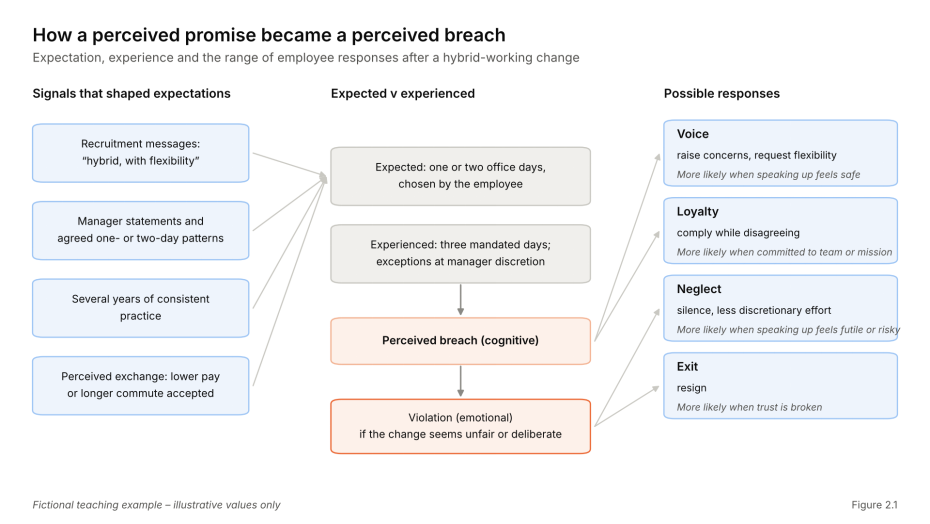
Figure 2.1. Fictional teaching example – illustrative values only. How recruitment messages, manager statements, practice and perceived exchange created an expectation of flexibility; how the new policy was experienced as a breach; and the range of employee responses. Principal limitation: the flow shows a theoretical mechanism, and individual employees will vary.
Common weaknesses in answers to this question
- Using “psychological contract” as a label rather than an explanation. Credit comes from analysing how the promise was formed and why it was perceived as breached.
- Failing to distinguish breach from violation. The distinction explains why responses vary and points to what the organisation can influence.
- Accepting the “resistance” framing. Strong answers evaluate it critically without dismissing the business rationale.
- Over-reading the evidence. A single trial or survey does not prove what will happen in this organisation; answers should state the limits of transferability.
- Omitting the legal context, or overstating it. Answers should identify the right to request, the forthcoming reasonableness test, custom and practice and equality law, while recognising that legal outcomes are fact-specific.
References
Acas (2024) ‘Acas Code of Practice on requests for flexible working’. Available at: https://www.acas.org.uk/acas-code-of-practice-on-flexible-working-requests (Accessed: 18 November 2026).
Bloom, N., Han, R. and Liang, J. (2024) ‘Hybrid working from home improves retention without damaging performance’, Nature, 630(8018), pp. 920–925. doi: 10.1038/s41586-024-07500-2.
CIPD (2025) Flexible and hybrid working practices in 2025. London: Chartered Institute of Personnel and Development. Available at: https://www.cipd.org/en/knowledge/reports/flexible-hybrid-working (Accessed: 18 November 2026).
Colquitt, J.A., Conlon, D.E., Wesson, M.J., Porter, C.O.L.H. and Ng, K.Y. (2001) ‘Justice at the millennium: a meta-analytic review of 25 years of organizational justice research’, Journal of Applied Psychology, 86(3), pp. 425–445.
Conway, N. and Briner, R.B. (2005) Understanding psychological contracts at work: a critical evaluation of theory and research. Oxford: Oxford University Press.
Department for Business and Trade (2026) Employment Rights Act 2025 factsheet: flexible working. London: Department for Business and Trade. Available at: https://assets.publishing.service.gov.uk/media/69a6bf1ca2495f2d259f1397/factsheet-flexible-working-feb-2026.pdf (Accessed: 18 November 2026).
Employment Rights Act 2025. London: The Stationery Office.
Equality Act 2010, c. 15. London: The Stationery Office.
Farrell, D. (1983) ‘Exit, voice, loyalty, and neglect as responses to job dissatisfaction: a multidimensional scaling study’, Academy of Management Journal, 26(4), pp. 596–607.
Guest, D.E. (2004) ‘The psychology of the employment relationship: an analysis based on the psychological contract’, Applied Psychology, 53(4), pp. 541–555.
Hirschman, A.O. (1970) Exit, voice, and loyalty: responses to decline in firms, organizations, and states. Cambridge, MA: Harvard University Press.
Morrison, E.W. (2014) ‘Employee voice and silence’, Annual Review of Organizational Psychology and Organizational Behavior, 1, pp. 173–197.
Morrison, E.W. and Robinson, S.L. (1997) ‘When employees feel betrayed: a model of how psychological contract violation develops’, Academy of Management Review, 22(1), pp. 226–256.
Office for National Statistics (2025) Who has access to hybrid work in Great Britain? Newport: ONS. Available at: https://www.ons.gov.uk/employmentandlabourmarket/peopleinwork/employmentandemployeetypes/articles/whohasaccesstohybridworkingreatbritain/2025-06-11 (Accessed: 18 November 2026).
Park Cakes Ltd v Shumba [2013] EWCA Civ 974.
Robinson, S.L. and Rousseau, D.M. (1994) ‘Violating the psychological contract: not the exception but the norm’, Journal of Organizational Behavior, 15(3), pp. 245–259.
Rousseau, D.M. (1989) ‘Psychological and implied contracts in organizations’, Employee Responsibilities and Rights Journal, 2(2), pp. 121–139.
Rousseau, D.M. (1995) Psychological contracts in organizations: understanding written and unwritten agreements. Thousand Oaks, CA: Sage.
Rousseau, D.M. (2005) I-deals: idiosyncratic deals employees bargain for themselves. Armonk, NY: M.E. Sharpe.
Rousseau, D.M., Hansen, S.D. and Tomprou, M. (2018) ‘A dynamic phase model of psychological contract processes’, Journal of Organizational Behavior, 39(9), pp. 1081–1098.
Zhao, H., Wayne, S.J., Glibkowski, B.C. and Bravo, J. (2007) ‘The impact of psychological contract breach on work-related outcomes: a meta-analysis’, Personnel Psychology, 60(3), pp. 647–680.