
Contents
Case brief: A public sector service (260 staff across 5 regional teams) is in the process of replacing 3 disparate case management systems with a single cloud based platform. The programme board have approved the technology, the supplier contract and the go-live date (9 months away). The board’s readiness report currently tracks just one metric: the % of staff who have completed the online training.
Early design workshops have highlighted the fact that the 5 teams record cases in different ways, have different definitions of a ‘closed’ case and are currently reliant on local spreadsheets which are outside of the existing systems. Team leads have reported very heavy caseloads and say they have absolutely no time to release staff to do any testing. Some staff are very keen on the new platform, others have said they’ve “seen it before” in the form of an earlier system which was ultimately scrapped.
Question. Critically evaluate how the organisation should assess its readiness to adopt the new case-management system. Recommend an approach to readiness assessment, stakeholder engagement and implementation governance that would increase the likelihood of successful adoption. Your answer should consider the limits of readiness measures and the risk of framing low readiness as employee resistance.
What the examiner is looking for is a good answer that makes the difference between readiness and enthusiasm and between readiness and just having completed training. A good answer will apply the change-readiness theory to the situation at both the individual and organisational level. It will use stakeholder analysis to work out who needs what level of involvement. It will acknowledge that readiness is a function of the organisation’s control of certain conditions (time, process clarity, leadership) and will recommend a governance structure that links the evidence to action. It will treat the readiness scores as a tool of judgement rather than as an objective score.
Model answer
Introduction
Technology programmes in the public sector have a very difficult track record. The NAO (2023) went on to say that whilst the government has put in place a number of digital strategies over the past 25 years, actual transformation of services at scale has been the exception rather than the rule. They make it very clear that transformation is not simply about the implementation of new systems and software, it’s about transformation of the way the business works and it’s about having a real understanding of the legacy systems and data.
The fictional programme here is a case in point and exhibits a number of the red flags. The technology is approved but the processes it’s meant to support are inconsistent. The only measure of readiness is training completion and staff capacity to get involved in the change is limited by existing workload.
This answer argues that readiness should be assessed as a set of conditions for adoption, not as a measure of staff attitudes. It first defines readiness and sets out the main theoretical perspectives. It then explains why training completion is an inadequate measure, before proposing a multi-dimensional readiness assessment, a stakeholder-engagement approach and a staged implementation roadmap. It considers the limits of readiness measurement and the risks of interpreting low readiness as resistance, and concludes with governance recommendations.
What readiness for change means
Armenakis, Harris and Mossholder (1993) defined readiness for change as the beliefs, attitudes and intentions of the members of an organisation as to the extent to which change is required and the organisation’s capacity to effect it successfully. They saw readiness as the cognitive antecedent to either support for or resistance to change and argued that leaders could in fact influence it through the messages they send and the conditions they create.
Holt et al (2007) developed a measure of individual readiness based on four beliefs: that the change is appropriate for the organisation, that leaders support it, that the individual is able to carry it out (change efficacy) and that the change will be of benefit to them. Each of those beliefs is a different lever. Someone may think the change is appropriate but not believe that leaders are in support of it. That’s precisely what the “we’ve seen this before” group are indicating.
Weiner (2009) put forward an organisational level theory in which readiness is a shared state consisting of change commitment (the shared determination of the members to go ahead with the change) and change efficacy (their shared belief in their ability to achieve the change). Weiner posited that change efficacy is a function of the judgements people make about the demands of the task, the resources available to them and the situational factors (e.g. time). This is relevant to the situation as a team may be fully committed to the new platform and yet still have no efficacy in relation to it as they simply don’t have the time to learn and trial it.
Rafferty, Jimmieson and Armenakis (2013) looked at the readiness literature and argued that readiness functions at the individual, group and organisational level and has both cognitive and affective elements. Their review makes it clear that group level readiness is not just the sum (or average) of individual levels of readiness. It’s a construct which emerges from the group’s shared experience and leadership.
Ready is a multi-dimensional, multi-level concept and is very much dependent on the conditions that the organisation can control.
Why training completion is an inadequate measure
The only readiness metric used by the Programme Board is the percentage of staff who have completed their online training. There are four issues with that.
First of all it measures an input not a capability. Completing a module doesn’t in any way demonstrate that the person can use the system to manage a complex case under time pressure.
Secondly it ignores process readiness. If the five teams have a different definition of a ‘closed’ case then training the staff on a common system is not going to produce consistent practice. It’s going to produce five different versions of practice within one system.
Thirdly it ignores data readiness. The local spreadsheets outside of the current systems suggest that the official data is incomplete. Taking that incomplete data into a new system is going to destroy the credibility of that system from day one.
Fourthly it ignores capacity. Weiner’s (2009) concept of change efficacy makes it very clear that people’s belief in their ability to change is contingent on the resources and time available to them. Staff with very heavy caseloads may just about manage to do the training at the last minute and end up with very little to take away.
A high training completion rate could therefore co-exist with very low readiness, providing a false sense of assurance to the programme board.
A multi-dimensional readiness assessment
The answer suggests looking at readiness across six dimensions, building on the theories mentioned and on Greenhalgh et al.’s (2017) NASSS framework. NASSS was developed from a range of studies of health and care technology programmes (including case management via data sharing) and found that programmes which were complex in a number of domains (the technology, the organisation and the wider system) were very rarely mainstreamed. Its focus on organisational capacity, work practices and the wider context is very relevant to a public sector case management system.
| Dimension | Question to answer | Evidence sources |
| Leadership alignment | Do senior and middle leaders share a consistent view of why the change is happening and what it requires? | Leadership interviews; consistency of messages; visible sponsorship |
| Process maturity | Are core processes and definitions agreed and consistent across teams? | Process mapping workshops; comparison of definitions |
| User capability | Can staff carry out real tasks in the new system? | Scenario-based practice in a test environment, not course completion |
| Workload capacity | Do teams have time to learn, test and adopt? | Caseload data; protected time agreed with team leaders |
| Data quality | Are records complete, accurate and ready to migrate? | Data profiling; reconciliation with local spreadsheets |
| Trust and history | Do staff believe the change will be sustained and will improve their work? | Structured listening; short readiness survey adapted from Holt et al. (2007) |
Table 1. Readiness dimensions and evidence sources.
Each dimension is scored on a simple scale (for example 1 to 5) by a small panel which will comprise programme staff, team leads and frontline representatives with the evidence for each score being recorded. In the hypothetical assessment of one regional team the results are as follows: leadership alignment 3, process maturity 2, user capability 2, workload capacity 1, data quality 2 and trust 2. The most pressing constraint is clearly workload capacity, followed by process maturity and data quality.
The value of the assessment is in the evidence more than the scores. A score of 1 on workload capacity, backed up by the caseload data (the team is at 115% of its planned caseload in this fictional example) tells the programme board exactly what it needs to know: unless capacity is created, the team simply can’t adopt the new system.
Readiness is not enthusiasm
The scenario does identify some staff as being enthusiastic. Enthusiasm is a good thing in itself but it doesn’t necessarily equate to readiness. In Holt et al.’s (2007) terms you could have enthusiastic staff who believe very much that the change is right and is going to be a good thing, but who still have no efficacy because they haven’t had any time to get their heads around it.
On the other hand you could have sceptical staff who are very capable users of the system and who simply don’t believe that the leaders will be able to carry the change through. That scepticism is very much a product of their experience of a previous system which had been abandoned. That’s exactly what Armenakis, Harris and Mossholder (1993) would have predicted.
It’s important to be able to identify these different groups so that the right interventions can be targeted at them. The enthusiastic but unprepared staff will need protected time and opportunity to practice. The sceptical but capable staff will need to see evidence of leadership commitment (e.g. decommissioning dates for the old systems, visible senior sponsorship, early resolution of the issues they raise).
The risk of framing low readiness as resistance
When readiness is low it’s very tempting to explain it as resistance on the part of individuals. The research suggests we should be careful. Ford, Ford and D’Amelio (2008) argued that “resistance” is often a term that change agents themselves use to describe what is happening and that it can mask the contribution of the change agents (e.g. broken agreements, poor communication, failure to involve the recipients).
They also argued that what is labelled as resistance can in fact be a useful resource as it brings to the surface problems in the design of the change. Oreg, Vakola and Armenakis (2011) in their review of 60 years of quantitative research into this area found that recipient reactions are a function of antecedents such as the nature of the change process, the perceived benefits and harms of the change and the context (e.g. level of trust in management, previous change experience) as much as individual disposition.
In the scenario the concerns of the staff are informative. Their scepticism is a pointer to the risk that the programme will simply repeat the earlier failure. The team leaders’ refusal to release staff is a pointer to a real capacity constraint. The discovery of the local spreadsheets is a pointer to gaps in the official data. To treat that as resistance is to ignore the very information the programme needs. The more useful managerial question is not ‘who is resisting?’ but ‘what conditions make adoption more or less feasible and what of those can we change?’
Stakeholder analysis and engagement
The programme has to work out who it will inform, who it will consult, who it will involve in the design and who will have the power to make the decisions. Mendelow’s (1991) power interest matrix is a useful starting point in that it allows you to categorise stakeholders according to their level of power and their level of interest. Bryson (2004) points out that such tools are only of any use if they lead to a considered engagement strategy and that public sector organisations in particular need to be mindful of those who are impacted but who have very little formal power.
| Stakeholder group | Power | Interest | Recommended involvement |
| Programme board and senior sponsor | High | High | Decision authority; accountable for readiness criteria |
| Regional team leaders | High (control staff time) | High | Participation in design; joint ownership of readiness scores |
| Frontline caseworkers | Medium (adoption depends on them) | High | Participation in process design and testing; structured voice |
| Data and IT specialists | Medium | High | Participation in data cleansing and migration |
| Trade union representatives | Medium | Medium | Consultation on workload, training time and any changes to roles |
| Service users | Low (formal) | High | Information; consultation on changes to how they are contacted |
| Supplier | Medium | High | Delivery partner; accountable for configuration |
Table 2. Illustrative stakeholder-influence analysis (fictional).
Two points arise. Firstly, team leads have far more real power than the organisation chart would suggest as they control staff time. You can’t get the capacity that you need for adoption without their buy-in. Secondly, service users have little formal power but considerable interest as their case records are inconsistent and this can impact on the service they get. Bryson’s (2004) warning about the need to involve users to a proportionate extent is very much in line with this (for instance by running a user panel to test out new communications).
The equality dimension
As a public body we are subject to the public sector equality duty (equality Act 2010, s. 149) which requires us to have due regard to the need to eliminate discrimination, promote equality of opportunity and foster good relations in the exercise of our functions. In practice this means we have to consider whether the new system and the way it is being rolled out will have a negative impact on certain groups.
This would include staff who use assistive technology (accessibility testing of the platform would be essential); part time staff (who may find it difficult to attend training on the fixed days); service users with limited digital access (if the new system changes the way they are contacted). Disabled staff may also be entitled to reasonable adjustments in relation to the training and the use of the system (Equality Act 2010, s.20). It is both a legal requirement and a good idea to build these considerations into the readiness assessment.
Technology acceptance and its limits
It could be argued that adoption is really down to whether the staff find the system useful and easy to use. The Technology Acceptance Model (Davis, 1989) and its subsequent development into the Unified Theory of Acceptance and Use of Technology (Venkatesh et al., 2003) both identify perceived usefulness, perceived ease of use, social influence and facilitating conditions as the key predictors of intention to use. They are a useful reminder to the programme that the design of the system is important and that facilitating conditions (i.e. time, support, infrastructure etc) are part of the acceptance process.
However they are very much focused on individual intention and are not really the right model for understanding adoption in complex organisations where you need all the processes, all the data and all the governance to change as part of the same process. Greenhalgh et al’s (2017) work was in part developed because the individual level acceptance models simply couldn’t explain why technology programmes didn’t scale and didn’t survive. The case management programme requires both of those perspectives: the individual level (usability) and the organisational level (processes, data and capacity).
A staged implementation roadmap
Readiness assessment is only going to be of any use if it in fact changes what the programme does. The answer proposes a phased approach with explicit readiness criteria at each gate.
Stage 1: Process clarification (months 1-3). Get the five teams together to agree on common definitions (what constitutes a ‘closed’ case for example) and a common core process. Variation at a local level is permitted only where there’s a very good reason for it. You absolutely cannot skip this stage or the new system will be full of inconsistencies.
Stage 2: Data cleansing (months 2-5). Profile the data in each of the legacy systems, reconcile it against the local spreadsheets and agree which records are going to migrate. Assign data quality owners in each team.
Stage 3: Pilot (months 4-6). Run the system with one team (chosen because it has sufficient capacity rather than because it’s the most enthusiastic) so that it’s the system that is being tested rather than the team’s enthusiasm. Measure task completion, error rates and time taken for real cases.
Stage 4: Role based practice (months 5-8). Replace the generic online training with role based practice in a test environment. This will be practice in the test environment, specifically tailored to the role. Agree protected time with line managers, with temporary cover provided by the programme where the caseloads make that necessary.
Stage 5: Go-live with a feedback loop (month 9). Go live team by team rather than all at once, with rapid response support and a clear channel for reporting problems. Publish what’s been fixed in response to the feedback to build trust.
Stage 6: Benefits review (at months 12 and 18). Check that the benefits that were expected have in fact materialised (e.g. reduced duplication of recording, more consistent case outcomes, better management information) and then decommission the legacy systems and local spreadsheets on the announced dates.
Each stage has a readiness gate. So a team won’t go live until it’s scored at least a 3 on every dimension, with evidence. If it doesn’t meet the criteria then the Programme Board have to decide whether to delay that team’s go-live, provide further support or accept the risk explicitly and record it.
Governance: linking evidence to decisions
Governance will determine whether the readiness evidence is actually acted on. Three arrangements are recommended.
Firstly, the readiness criteria should be the responsibility of the Programme Board rather than just the project team. That way decisions to go ahead with a project despite it being of low readiness are taken at the correct level and are properly documented.
Secondly, readiness should be reported as a profile with evidence rather than a single number. You could use a radar chart to bring the six dimensions of readiness for each team together in one profile, but that chart must always be accompanied by a table which sets out the evidence for each score, who gave that score and where the panel actually disagreed.
Thirdly the programme should have resources on hand to deal with readiness gaps, in particular funding to cover the temporary release of staff to enable training and testing. The NAO (2023) found that funding for the remediation of legacy systems and data as part of the transformation effort was required rather than being an after the event item; the same applies to the people capacity that will be required for adoption.
Limits of readiness assessment
A readiness assessment can assist in making decisions but can’t guarantee success and its limitations must be acknowledged.
Scores are judgements rather than measurements. Even where they are based on structured evidence they are the view of a panel. They should be presented as aids to discussion rather than as objective psychological measures.
Readiness will change over time. A team that is ready at month 4 may not be ready at month 8 if the caseloads go up. The assessment needs to be done at each gate.
Measurement can influence behaviour. If readiness scores are used to rank teams publicly or to justify some form of sanction then teams will have an incentive to inflate their readiness and the assessment will be rendered pointless. Scores should be used to target support.
Popular claims about change failure need to be treated with some caution. The oft-repeated figure that 70% of change programmes fail has no valid empirical basis according to Hughes (2011). There’s no evidence to support a single failure rate. The case for a rigorous readiness assessment is not predicated on that statistic at all. It’s based on the specific evidence from this programme.
Counter-arguments
The Programme Board may well argue that a staged approach with readiness gates will in fact delay go-live and increase cost. That’s a perfectly valid objection. Delays have their own costs (continued spend on the three legacy systems, for instance) and there is a risk of simply losing momentum. The response to that objection is not that we should always delay.
The point is that the Board need to make a decision. A readiness gate doesn’t have to be a stoppage. It needs to be a point at which the Board can make a decision on the evidence, to either proceed, to support or to delay. You may well be in a position where you do want to proceed with known gaps and that may be the right decision. That would be a decision that would be properly recorded with a mitigation plan in place rather than just an unintended consequence of only measuring training completion.
It could equally be argued that a multi-dimensional assessment is simply too complex for a busy service. The six dimensions could be assessed with very little effort indeed (a short survey, the existing caseload and data reports, one workshop per team) and the cost would be negligible in comparison to the cost of a failed implementation.
Conclusion
The fictional programme has approved the technology but has not yet assessed whether its organisation is capable of adopting it. Its sole readiness metric is training completion which is an input rather than a capability and says nothing about process maturity, data quality, workload capacity or trust. Change readiness theory tells you that readiness is multi-dimensional and multi-level and is very much dependent on the conditions that the organisation can control. A low readiness score is therefore not a judgement on the people; it’s often a reflection of the fact that the organisation hasn’t yet provided the time, the stable processes or the credible leadership that adoption requires.
The recommended approach looks at readiness across six evidence-based dimensions, engages stakeholders according to their level of power and level of interest (including those with minimal formal power), meets the public sector equality duty and links the readiness evidence to decisions via a staged roadmap with gates owned by the programme board. Readiness scores are to be treated as judgement aids rather than as objective measures, the assessment is to be repeated over time and it’s to be used to target support rather than to rank the teams. This will make it much more likely that the new system gets adopted, gets sustained and is in fact used to improve the service.
Figure 3.1
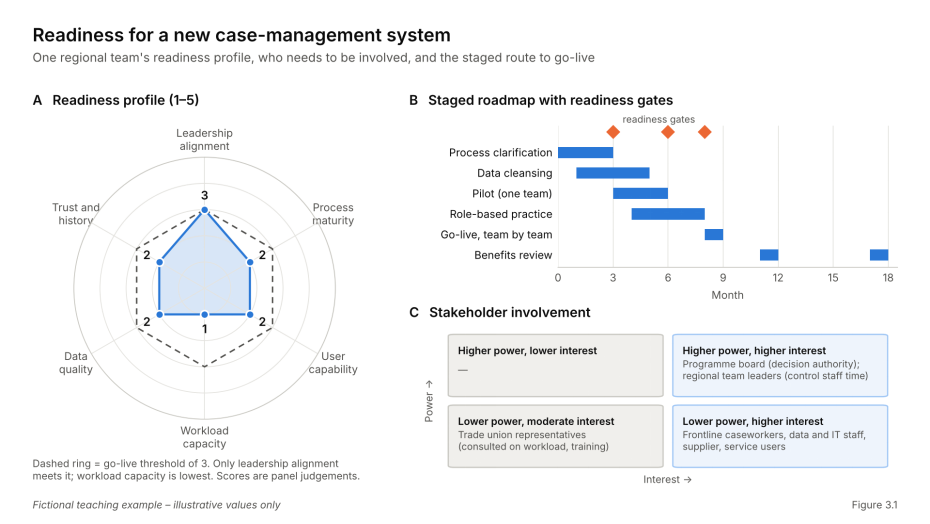
Figure 3.1. Fictional teaching example – illustrative values only. One regional team’s readiness profile for a new case-management system, the staged roadmap with readiness gates, and which stakeholders need what kind of involvement. Only leadership alignment meets the go-live threshold of 3; workload capacity is lowest. Principal limitation: readiness scores are panel judgements, not objective measurements.
References for Assessing Change Readiness Example
Armenakis, A.A., Harris, S.G. and Mossholder, K.W. (1993) ‘Creating readiness for organizational change’, Human Relations, 46(6), pp. 681–703.
Bryson, J.M. (2004) ‘What to do when stakeholders matter: stakeholder identification and analysis techniques’, Public Management Review, 6(1), pp. 21–53.
Davis, F.D. (1989) ‘Perceived usefulness, perceived ease of use, and user acceptance of information technology’, MIS Quarterly, 13(3), pp. 319–340.
Equality Act 2010, c. 15. London: The Stationery Office.
Ford, J.D., Ford, L.W. and D’Amelio, A. (2008) ‘Resistance to change: the rest of the story’, Academy of Management Review, 33(2), pp. 362–377.
Greenhalgh, T., Wherton, J., Papoutsi, C., Lynch, J., Hughes, G., A’Court, C., Hinder, S., Fahy, N., Procter, R. and Shaw, S. (2017) ‘Beyond adoption: a new framework for theorizing and evaluating nonadoption, abandonment, and challenges to the scale-up, spread, and sustainability of health and care technologies’, Journal of Medical Internet Research, 19(11), e367. doi: 10.2196/jmir.8775.
Holt, D.T., Armenakis, A.A., Feild, H.S. and Harris, S.G. (2007) ‘Readiness for organizational change: the systematic development of a scale’, Journal of Applied Behavioral Science, 43(2), pp. 232–255.
Hughes, M. (2011) ‘Do 70 per cent of all organizational change initiatives really fail?’, Journal of Change Management, 11(4), pp. 451–464.
Mendelow, A. (1991) ‘Stakeholder mapping’, Proceedings of the 2nd International Conference on Information Systems. Cambridge, MA.
National Audit Office (2023) Digital transformation in government: addressing the barriers to efficiency. HC 1171, Session 2022–23. London: NAO. Available at: https://www.nao.org.uk/wp-content/uploads/2023/03/digital-transformation-in-government.pdf (Accessed: 18 November 2026).
Oreg, S., Vakola, M. and Armenakis, A. (2011) ‘Change recipients’ reactions to organizational change: a 60-year review of quantitative studies’, Journal of Applied Behavioral Science, 47(4), pp. 461–524.
Rafferty, A.E., Jimmieson, N.L. and Armenakis, A.A. (2013) ‘Change readiness: a multilevel review’, Journal of Management, 39(1), pp. 110–135.
Venkatesh, V., Morris, M.G., Davis, G.B. and Davis, F.D. (2003) ‘User acceptance of information technology: toward a unified view’, MIS Quarterly, 27(3), pp. 425–478.
Weiner, B.J. (2009) ‘A theory of organizational readiness for change’, Implementation Science, 4, 67. doi: 10.1186/1748-5908-4-67.