Contents
Unit 5CO02 (Evidence-Based Practice) is often cited by students as one of the most challenging modules in the CIPD Level 5 Associate Diploma. It requires a shift in mindset from “HR as a feeling” to “HR as a science.” Many students struggle with the technical requirements of data analysis, the critical evaluation of evidence, and the integration of financial and non-financial metrics.
At Elite Assignment Help, we have analysed hundreds of submissions and identified the specific CIPD 5CO02 Evidence Based Practice Common Failures that lead to referrals. By understanding these risks, you can ensure your assignment demonstrates the rigorous, evidence-based approach that CIPD assessors expect.
The Data Analysis Gap
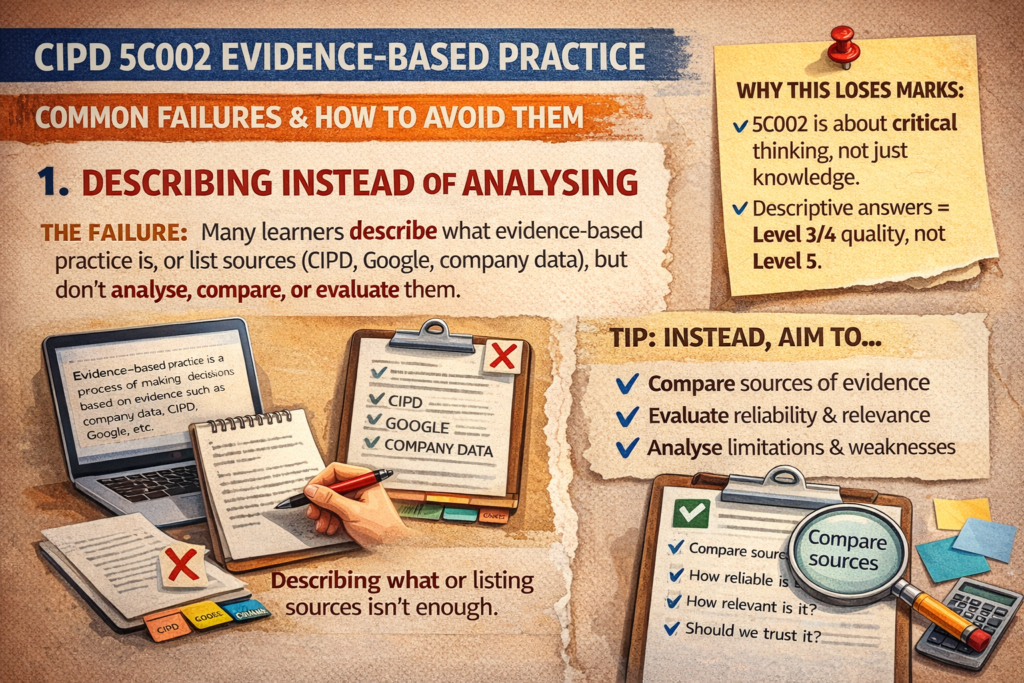
The first task in 5CO02 often involves analysing a set of organizational data (e.g., turnover rates, absence data, or engagement scores). A common failure point is providing a description of the data rather than an analysis of the trends.
Descriptive (Fail): “The turnover rate in Q1 was 10%, and in Q2 it was 12%. This shows that turnover is increasing.”
Analytical (Pass): “The 2% increase in turnover between Q1 and Q2 represents a significant trend when viewed alongside the 15% decrease in engagement scores reported in the same period. This suggests a correlation between the recent restructuring and employee retention, which requires further investigation using qualitative evidence such as exit interviews.”
The assessor is not testing your ability to read a chart; they are testing your ability to interpret the implications of that data for the business.
Superficial Evaluation of Evidence-Based Practice (EBP)
Criterion 1.1 often asks you to “Evaluate the concept of evidence-based practice.” Many students fail here by providing a simple definition of EBP.
The Evaluative Requirement: To pass, you must move beyond the definition to discuss the benefits and limitations of EBP. You should consider:
- How EBP improves decision-making and organizational performance.
- The challenges of implementing EBP (e.g., lack of data literacy, time constraints, or “gut feeling” culture).
- The importance of using a range of evidence (Stakeholder concerns, Practitioner expertise, Organizational data, and External research).
Weak Integration of Financial and Non-Financial Metrics
A core part of 5CO02 is understanding how HR activities impact the “bottom line.” Many students struggle to link HR metrics (like absence rates) to financial outcomes (like the cost of temporary cover or lost productivity).
The Failure: Treating HR metrics in isolation from the wider business context. The Success: Demonstrating how a 1% reduction in absence, achieved through a new wellbeing initiative, translates into a specific financial saving or an increase in operational capacity. This shows the assessor that you understand the commercial impact of HR.
—-> Also See
- Learning Needs Analysis: From Performance Gap to Development Plan
- HR Benchmarking: Internal, External and Competitive Comparisons
- ADDIE Model: Designing Effective Workplace Learning
- Kirkpatrick Model: Evaluating Learning Beyond Completion Rates
- Qualitative and Quantitative Evidence in People Practice
- HR Data Quality: Accuracy, Completeness and Meaningful Interpretation
- People Analytics Ethics: Privacy, Fairness and Responsible Decision-Making
- People Analytics and Workforce Planning: Turning Data into Action
- Return on Investment in People Interventions: Benefits, Limits and Measurement
- CMI Leadership Models: Selecting, Applying and Critically Evaluating Them
Beat Your Deadline
Hire a Writer Today!
✅ Get Your Assignment, Essay, Dissertation, Research Done by Experts
Misinterpreting “Stakeholder Perspectives”
When asked to consider stakeholder perspectives, many students only think of “employees” or “managers.” They fail to consider the diverse and often conflicting needs of different stakeholder groups (e.g., shareholders, customers, unions, or regulatory bodies).
The Critical Approach: A successful 5CO02 submission will analyse how an evidence-based decision might be perceived differently by different groups. For example, a data-driven decision to automate a process might be welcomed by shareholders (for cost savings) but resisted by employees (due to job security concerns).
The “Reflection” Missing Link
The final part of 5CO02 often requires a reflection on your own professional development and how you have applied evidence-based practice. As we discuss in our guide on Reflective Failure, this section is often rushed and becomes purely descriptive.
The 5CO02 Reflection: You must specifically reflect on how your data literacy and critical thinking have evolved during the unit. How will you use evidence differently in your future HR role?
How We Prevent 5CO02 Failures
Our Failure-Prevention Framework for 5CO02 is highly technical and data-focused.
- Data Interpretation Coaching: We help you move from “reading the numbers” to “analysing the story” behind the data.
- EBP Framework Alignment: We ensure your evaluation of EBP covers all four pillars of evidence required by the CIPD.
- Commercial Impact Mapping: We help you draw the logical links between HR metrics and financial performance.
- Stakeholder Analysis: We guide you in identifying and analysing a broad range of stakeholders to add depth to your arguments.
- Evidence Quality Audit: We ensure that the external research you cite is current, credible, and relevant to the unit’s themes.
Master the Science of HR
5CO02 is a pivotal unit that defines your credibility as a modern HR professional. By avoiding these common pitfalls, you demonstrate that you are not just an “HR practitioner,” but an evidence-based business partner.
At Elite Assignment Help, we specialize in the technical nuances of 5CO02. We help you turn complex data into a compelling, evidence-based argument that secures a first-time pass.
Related Failure Prevention Guides:
- Why Reflection is the Main CIPD Failure Point
- Why Word Count Does Not Guarantee Success
- Misinterpreting CIPD Assessment Criteria
For a complete overview of our approach, visit our Assignment Failure Prevention Page.