Contents
One of the most common reasons for assignment failure is the “Big Bang” approach—where a student attempts to write a 3,000 to 5,000-word CMI or CIPD assignment in one or two marathon sessions just before the deadline. This is exactly why Staged Delivery: Preventing Quality Breakdowns in Complex Assignments is essential for achieving consistent, high-quality results. The last-minute approach almost inevitably leads to a breakdown in quality, consistency, and critical depth.
At Elite Assignment Help, we advocate for a Staged Delivery model. By breaking the assignment into manageable “sprints” and conducting quality checks at each stage, we eliminate the risks associated with rushing and ensure that every section of your submission meets the required academic and professional standard.
The Risks of the “Big Bang” Approach
When you attempt to write a complex assignment in a single stage, several predictable “quality breakdowns” occur:
- Criterion Fatigue: You may start strong on the first few criteria but lose focus and depth as you reach the end of the document.
- Loss of Cohesion: The links between different sections (e.g., the link between your SWOT analysis and your strategic recommendations) become weak or non-existent.
- Referencing Errors: Rushing leads to sloppy Harvard referencing, which is a common cause of minor but frustrating referrals.
- Superficial Reflection: Reflection requires time and thought. When rushed, it often becomes purely descriptive, failing the evaluative standard required by the CIPD.
What is Staged Delivery?
Staged Delivery is a project management approach to assignment writing. Instead of seeing the assignment as one giant task, we view it as a series of interconnected modules. Each module is developed, reviewed, and refined before moving on to the next.
The Stages of Success
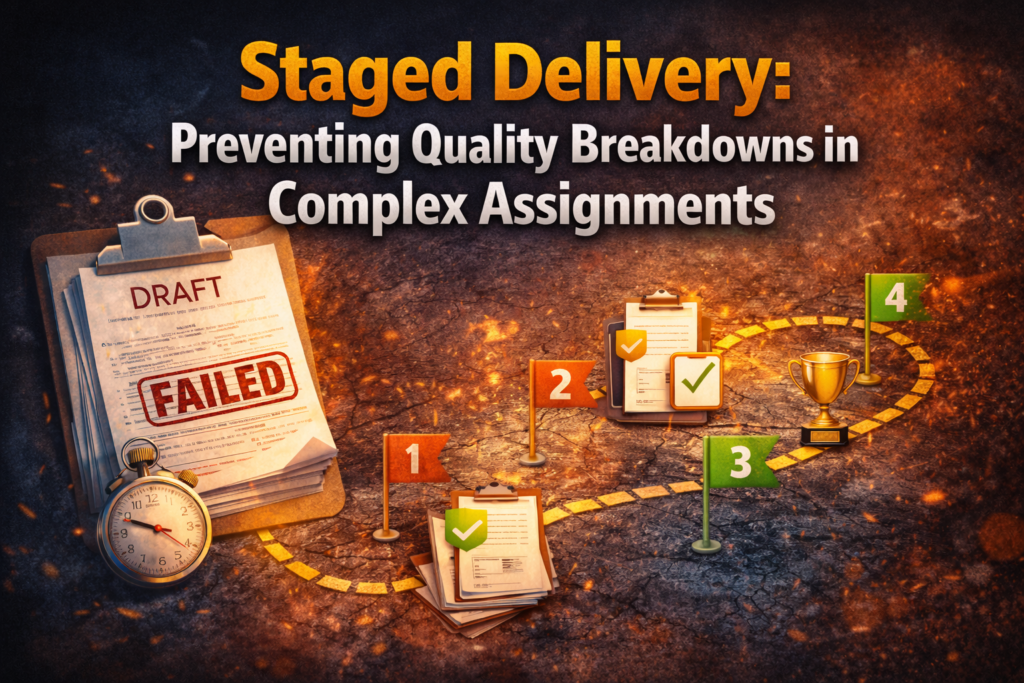
Our Staged Delivery framework typically follows these four key phases:
- Phase 1: The Structural Blueprint: Based on the Diagnostic Review, we finalize the structure, headings, and the specific models to be used for each criterion. This ensures the “skeleton” of the assignment is robust.
- Phase 2: Core Analysis Sprints: We break the assignment into 2-3 sections (e.g., Task 1, Task 2). You focus on drafting one section at a time, ensuring that the command verbs and indicative content are fully addressed.
- Phase 3: The Integration & Reflection Stage: Once the core analysis is complete, we focus on the “connective tissue”—ensuring the arguments flow logically and that the reflective sections meet the required evaluative depth.
- Phase 4: The Final Quality Audit: A comprehensive review of the entire document, checking for consistency, academic tone, referencing accuracy, and alignment with the assessment grid.
Beat Your Deadline
Hire a Writer Today!
✅ Get Your Assignment Done by Experts
The Benefits of Incremental Quality Checks
The primary advantage of Staged Delivery is the ability to catch errors early. If you misinterpret a criterion in Task 1, it’s much easier to fix it before you’ve written Task 2 and 3.
| Feature | Big Bang Approach | Staged Delivery Model |
| Stress Levels | High (especially near the deadline). | Managed and predictable. |
| Critical Depth | Often inconsistent or superficial. | Consistently high across all sections. |
| Error Detection | Only caught at the very end (or by the assessor). | Caught and corrected at each stage. |
| Cohesion | Sections often feel disconnected. | Strong logical flow and integration. |
Why Staged Delivery is Essential for Level 7
For CMI Level 7 and CIPD Level 7 qualifications, Staged Delivery is not just a “nice to have”—it’s essential. These assignments require a high level of synthesis and critical evaluation. You cannot “rush” a strategic argument. It needs time to be developed, challenged, and refined.
By using a staged approach, you allow yourself the “mental space” to think strategically. You can draft a section on organizational culture, step away, and then return to it with a fresh perspective to add the critical depth that Level 7 assessors demand.
Our Commitment to Your Success
At Elite Assignment Help, we don’t just provide a service; we provide a structured path to success. Our Staged Delivery model is designed to protect you from the common pitfalls of academic writing. It ensures that your final submission is not just a collection of words, but a coherent, high-quality professional document that reflects your true expertise.
By breaking the process down, we turn a daunting task into a manageable journey, ensuring you cross the finish line with a pass, the first time.
Related Failure Prevention Guides:
- Diagnostic Review: Preventing Assignment Failure
- Why Word Count Does Not Guarantee Success
- Why CMI Assignments Lack Depth
For a complete overview of our approach, visit our Assignment Failure Prevention.