Category: CMI
-
A workforce plan should not assume that one forecast will prove correct. When technology, demand, regulation, labour markets or operating models are uncertain, the more useful question is: what workforce choices will remain credible across several plausible futures? Scenario planning helps answer that question. It is a structured way of exploring how important uncertainties might…
-
PESTLE vs Porter’s Five Forces are often placed together in strategy work, but they answer different questions. PESTLE scans the wider macro environment. Porter’s Five Forces examines the competitive structure of a specific industry. A strong strategy process uses the tool that fits the decision, then connects the findings to internal capability, customer needs and implementation…
-
Growth is not a single decision. An organisation may grow by selling more of its current offer to current customers, taking an existing offer into a new market, developing a new offer for existing customers or entering an unfamiliar product-market space. The Ansoff Matrix provides a simple way to compare those four directions before leaders commit…
-
A strategy can appear convincing while its operating logic remains unclear. Leaders may agree that an organisation should grow, digitise, enter a market or redesign a service, yet have not established who will receive value, why they will choose the offer, how delivery will work, what capabilities are needed or whether the economics are plausible.…
-
Balanced Scorecard vs KPIs vs OKRs are often presented as alternatives. They are better understood as different levels of a performance-management system. A Balanced Scorecard translates strategy into a balanced set of objectives and measures. KPIs track the health or performance of a critical activity or outcome. OKRs focus people on a small number of…
-
Two organisations can operate in the same market, face the same regulation and use similar technologies, yet produce very different results. The Resource-Based View (RBV) helps explain why. It directs attention to the resources, capabilities, knowledge, relationships and organisational routines that enable one organisation to create value more effectively than another. The VRIN framework provides a…
-
A strategy can be technically sound and still fail because the people and groups affected by it were misunderstood, engaged too late or treated as an afterthought. Stakeholder mapping helps leaders see who can influence a decision, who is affected by it, what they may need and how engagement should be planned. The power-interest matrix is…
-
Organisations often describe a strategic change as a systems, structure or process problem. The change then struggles because the surrounding organisation remains unchanged: employees lack the necessary skills, leadership behaviour contradicts the strategy, performance systems reinforce old priorities or shared values are ignored. The McKinsey 7S Framework helps leaders diagnose these alignment problems. The practical answer: use…
-
Remote and multi-disciplinary teams do not fail because people work in different locations or bring different expertise. They fail when goals are unclear, role interfaces are weak, information is unevenly available, collaboration is accidental and performance is confused with online visibility. The practical answer: manage remote and multi-disciplinary team performance through a shared operating system: clear…
-
Strategic Business Proposals is not a long description of a problem or a list of attractive recommendations. It is a reasoned case for action that shows why a change is needed, what options exist, how affected stakeholders will be engaged, what resources and risks must be managed, and how leaders will know whether the intended…
-
Leadership style is not a personality label or a permanent preference. It is the way a manager exercises authority, organises work and relates to colleagues. It is visible in priorities, communication, decision-making, delegation, feedback and the example a leader sets (CMI, 2020). The practical answer: select a leadership approach by diagnosing the task, risk, capability, confidence,…
-
Management and leadership are sometimes presented as opposites: management is said to be about control, while leadership is said to be about inspiration. This is too simple for real organisations. A team can have an inspiring direction but fail because work is not planned, governed or resourced. It can also have efficient processes but struggle…
-
Two Team Models for Different Management Questions Tuckman VS Belbin team models are often introduced together because both help managers think about teams. They are not, however, competing models. Tuckman explains how a team may develop over time; Belbin examines the behavioural contributions that people may bring to a team. One is principally about team development…
-
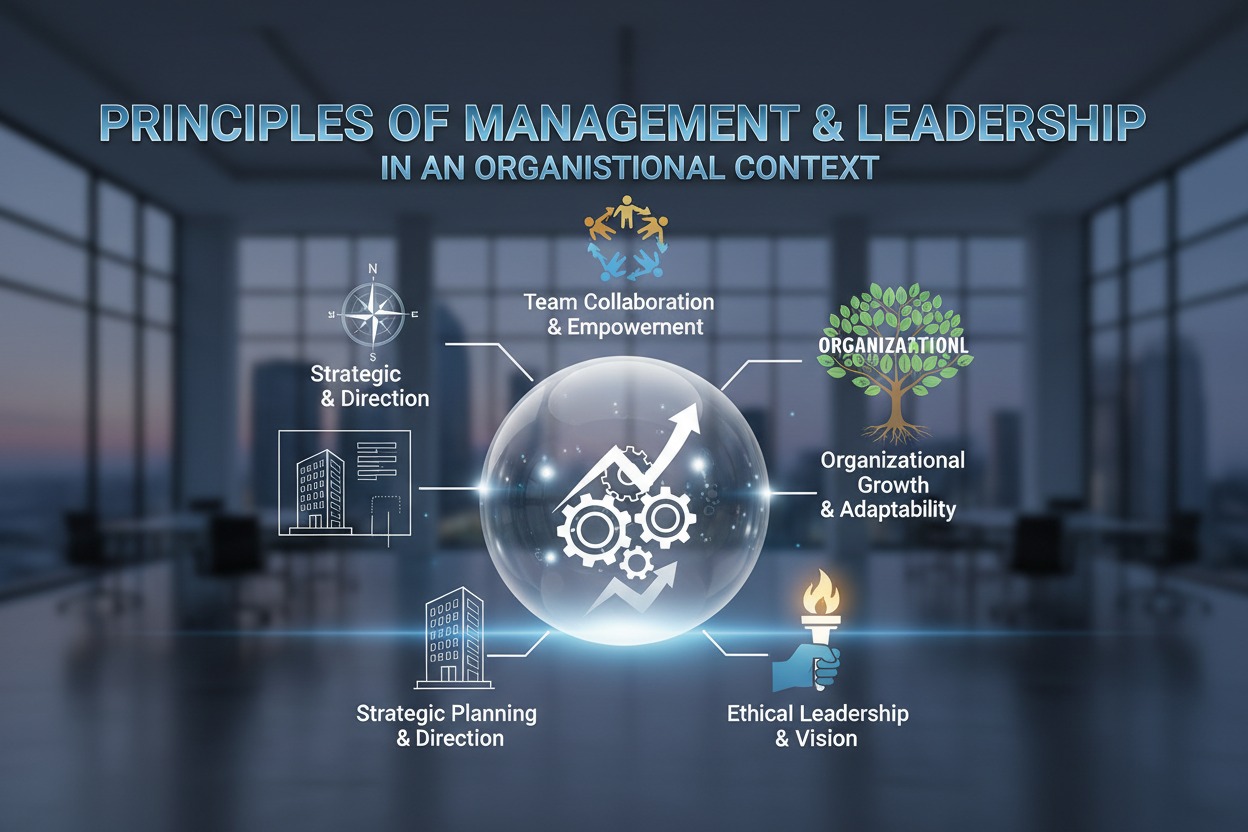
Effective organisational performance hinges on a profound understanding of management and leadership principles. This CMI 501 Assignment Example comprehensively examines the internal and external factors shaping an organisation’s operational landscape. It critically analyses the impact of legal status, mission and vision statements, and organisational structures on management roles. Furthermore, it investigates the intricate relationship between…
-
The role of leadership has transcended traditional management boundaries, evolving into a complex practice that demands ethical integrity, strategic foresight, and the ability to navigate diverse organisational cultures. Leadership is no longer merely about directing activities; it is about inspiring a shared vision, fostering a culture of responsibility, and adapting to a myriad of internal…
-

In an Organisation characterised by rapid technological advancement, global interconnectedness, and an increasingly diverse workforce, the effective management and leadership of individuals and teams have become paramount for sustained success. CMI 503 Assignment Example undertakes a comprehensive exploration of the foundational principles and advanced strategies requisite for cultivating high-performing teams and fostering individual growth within…
-

CMI 704 Assignment Example will explore the Multidimensional process of developing organisational strategy, drawing upon contemporary theories and practical applications relevant to Level 7 strategic leadership. The focus will be on critiquing the factors that drive strategy development, appraising various strategic approaches, and discussing the inherent challenges in leading and implementing strategic change within complex…
-

The role of the strategic leader has evolved from mere operational oversight to navigating complex, multifaceted challenges. Strategic leaders are now required to possess not only a robust technical skillset but also a dynamic mindset capable of continuous adaptation. Consequently, personal and professional development is no longer a peripheral activity but a central, strategic imperative.…
-

Context for CMI 705 Assignment Example The chosen organisation for this CMI 705 Assignment Example is the National Health Service (NHS) England, specifically focusing on the implementation of the Federated Data Platform (FDP). The NHS is a large-scale, public sector organisation providing comprehensive healthcare services across the United Kingdom. The FDP initiative represents a significant…