
Contents
The examinable question
Case brief. You are the audit senior on the audit of a UK electronics distributor for the year ended 30 September 2026. Inventory at year end is £18.4m (up from £12.1m the previous year) and cost of sales has only increased from £75m to £81m. Overall materiality is £0.9m. The product mix is changing quite rapidly and a number of the product lines (including the older laptop range and the 4G network equipment) have not sold very much for months.
Management have provided us with an inventory ageing report which has been produced by the company’s ERP system and have recorded a write-down of £0.3m. The FD is of the opinion that no further write-down is required as a marketing campaign for the new year will clear the older stock. A portion of the inventory is held at a third party warehouse.
Question. Evaluate the audit evidence required to reach a conclusion on the inventory balance. Your answer should identify the relevant assertions and risks, assess the relevance and reliability of the evidence at hand, describe the procedures you would carry out and explain how you would respond to management’s position on the write-down. Conclude on the course of action the auditor should take if the evidence does not support management’s figure.
What the examiner is looking for is an answer that links the evidence to the specific assertions. It’s an answer that can tell the difference between relevant and reliable evidence and can explain why the same piece of evidence might be sufficient for one assertion and not for another. It treats the write-down as an accounting estimate open to management bias and applies a degree of professional scepticism to management’s position. It can explain why written representations cannot in themselves be sufficient. And it will reach a conclusion which is conditional on the evidence.
Model answer
Introduction
Inventory is always a classic high risk area in the audit of a trading company. It’s often a material item, you’ve got physical assets that have to be there, and the valuation is dependent on management’s judgements as to future selling prices. In this instance there are a number of red flags: inventory is up 52% and cost of sales is up 8%, the product lines are becoming increasingly obsolete and management have only recorded a very small write-down, despite the fact that they are claiming that a future campaign will clear the old stock.
The auditor’s objective is to obtain sufficient appropriate audit evidence on which to base their conclusion as to whether the inventory balance is free from material misstatement. Under ISA (UK) 500, sufficiency measures the quantity of evidence and appropriateness measures its quality (relevance and reliability) (Financial Reporting Council, 2022). This answer reviews the assertions at risk, considers the available evidence, sets out the procedures for existence and valuation, considers how to respond to management’s argument, and explains how the auditor would reach their conclusion.
Understanding the risk
The first thing to do is understand why inventory is such a big risk in this engagement. Three analytical indicators are useful.
Inventory days have increased from around 59 days (59 days x £12.1m / £75m) to around 83 days (83 days x £18.4m / £81m). The company is clearly holding its stock for a lot longer.
Ageing profile: ERP ageing report shows £11.2m aged 0-90 days, £3.9m aged 91-180 days, £2.1m aged 181-365 days and £1.2m over a year. Over £3.3m is over 6 months old in a sector where products go down in value very quickly.
Write down on the aged stock. The write-down recorded of £0.3m is less than 10% of the inventory aged over 6 months.
Together, these point to a risk of inventory being overstated, as cost exceeds net realisable value. There is also a risk regarding existence, given that the inventory is held at more than one location, including a third-party warehouse.
ISA (UK) 540 (Revised December 2018) requires the auditor to consider accounting estimates (including inventory write-downs) to be subject to estimation uncertainty, complexity and subjectivity and to be alert to indicators of management bias (Financial Reporting Council, n.d.). The finance director’s argument that the write-down is low because it is based on an uncertain future event is a potential indicator of bias.
With the revision of ISA (UK) 240 in March 2026 (applying to audits of periods beginning on or after 15 December 2026) there has been further emphasis on the importance of risk assessment for fraud. This audit is prior to that date but the same professional attitude is required: where estimates are capable of being influenced by management they should be looked at with a very high degree of care (Financial Reporting Council, 2026).
The relevant assertions
Evidence must be linked to the assertions it is intended to support. For inventory, the most relevant assertions are:
• Existence: the inventory recorded is at year-end.
• Completeness: all inventory owned by the company is recorded.
• Rights and obligations: the company owns the stock and it is not held on behalf of any third party or pledged without disclosure.
• Accuracy, valuation and allocation: inventory is at the lower of cost and net realisable value in accordance with IAS 2 and cost is correctly calculated.
• Cut-off: purchases and sales are recorded in the correct period.
The biggest risks are around valuation (NRV) and to a lesser extent existence at the 3rd party warehouse. The rest of this answer is going to be about those two, whilst acknowledging that the other assertions will also require support.
Relevance and reliability of evidence
A fundamental concept in audit evidence is that evidence may be relevant to one assertion and not to another, and that evidence which is relevant may still be unreliable. Table 1 looks at the principal sources of evidence.
| Evidence | Source | Relevant to | Reliability considerations | Main limitation |
| ERP ageing report | Internal, system-generated | Valuation (indicates slow-moving items) | Depends on IT controls and on how “age” is defined | May not reflect true age if movement dates reset |
| Attendance at inventory count | Auditor’s direct observation | Existence, condition | High, because obtained directly by the auditor | Does not establish value; condition may be hard to judge for sealed electronics |
| Third-party warehouse confirmation | External | Existence, rights | Generally reliable if obtained directly by the auditor | Confirms quantities held, not condition or value |
| Post-year-end sales invoices and cash receipts | Internal and external | Valuation (net realisable value) | High, especially when matched to cash received | Covers only items sold after the year end |
| Price lists and supplier notifications | External | Valuation | Moderate to high | List prices may differ from achievable prices |
| Management’s campaign plan | Internal, prepared by management | Valuation (management’s assumptions) | Low, because it is prospective and prepared by the party whose estimate is being tested | Future intentions, not evidence of conditions at year end |
| Written representation from management | Internal, from management | All assertions | Low on its own | Cannot substitute for other evidence |
Table 1. Evaluating the evidence for the inventory balance (fictional).
Two general principles underlie the reliability column. Firstly, evidence obtained directly by the auditor or from independent external sources is generally more reliable than evidence obtained from the entity. Secondly, evidence obtained from the entity is more reliable where the controls over its preparation are effective. Both of these principles are reflected in ISA (UK) 500 (Financial Reporting Council, 2022).
Testing the ageing report
The aged report is the starting point for identifying slow moving stock but you can’t assume it’s reliable. You need to understand how the system works out the ‘age’ and test that the calculation is correct. That will involve testing the relevant IT general controls (i.e. the controls over changes to the ERP system) and reworking the ageing for a sample of items.
In the fictional audit the reperformance identifies a problem. The ERP defines age on the ‘last movement date’ and any movement (whether a customer return or a transfer between warehouses) will reset that date. A batch of older laptops returned by a customer in August 2026 are recorded as 0-90 days old even though they were purchased 14 months earlier and have not been sold since. A sample of 40 items from the 0-90 day batch shows that 7 of them have been ‘refreshed’ by a return or transfer.
This highlights the difference between relevance and reliability. The ageing report is very relevant to valuation, as age is a good indicator of obsolescence. It measures how long the stock has been on the books, though it’s not reliable because the system’s definition of age is flawed. The auditor should therefore obtain an alternative measure (i.e., the date of last sale for each product line) and test the extent of the problem.
Evidence for existence
For existence, ISA (UK) 501 requires the auditor (where inventory is material) to be present at the physical inventory count (unless impracticable), to assess management’s count instructions and procedures, to observe the count, to inspect the inventory and to carry out test counts (Financial Reporting Council, 2025). In this engagement the auditor should:
• review the count instructions prior to the count to ensure they cover the separation of the slow moving and damaged and the goods in transit;
• attend the count at the main warehouse, check that the instructions are being followed and do test counts both ways (from the count sheets to the floor to check existence and from the floor to the count sheets to check completeness);
• note the condition of inventory, particularly any obviously damaged or obsolete items, and whether old stock is identified;
• record the cut-off information (i.e. the last goods received, and the last goods despatched) for subsequent testing.
For inventory held at the third party’s warehouse, ISA (UK) 501 allows the auditor to request confirmation from the third party as to the quantities and condition of the inventory on the entity’s behalf, or to carry out inspection or other appropriate procedures. The third-party inventory is material and includes some of the oldest lines, so confirmation alone may not be sufficient. Confirmation will tell you that the warehouse has a certain quantity but will tell you nothing about condition or saleability. Depending on the amount involved, the auditor may also attend a count at the warehouse or inspect the slow-moving stock held there.
Evidence of existence doesn’t establish value. You can look at a pallet of 4G routers and see that the routers exist, that’s all it proves. It tells you nothing about their value in terms of whether they can be sold for more than they cost.
Evidence for valuation
IAS 2 requires inventory to be measured at the lower of cost and net realisable value, net realisable value being defined as the estimated selling price in the ordinary course of business less the estimated costs of completion and the estimated costs to complete the sale (International Accounting Standards Board, 2003). The standard also requires that the estimates of net realisable value be based on the best evidence available at the time the estimates are made and that price changes and events which occur after the end of the period be taken into account to the extent that they confirm the state of affairs at the end of the period.
That principle is directly linked to IAS 10, which provides that the sale of inventory after the reporting period of an adjusting event may provide evidence as to the net realisable value of the inventory at the reporting date (International Accounting Standards Board, 2003). Post-year-end sales are therefore one of the most compelling pieces of evidence.
In the ‘fictional’ audit, we look at the sales of inventory aged over 6 months in Oct and Nov 2026. Of the £3.3m aged over 6 months at year-end (ERP ageing before correction), there have been sales of £0.6m at an average selling price (after deduction of selling costs) of 62% of cost. For the older laptop models, that figure is 48%. For some lines, there have been no sales at all.
This evidence demonstrates that for at least a portion of the aged stock, net realisable value is significantly below cost. In conjunction with the correction to the ageing report, the auditor can arrive at an independent estimate. ISA (UK) 540 permits the auditor to address the risks relating to an estimate in one of three ways: by testing management’s process, by arriving at an auditor’s own point estimate or range, or by obtaining evidence from events which occurred up to the date of the auditor’s report (Financial Reporting Council, n.d.).
The auditor used the post-year-end selling prices by product line, the corrected ageing, and the supplier price notifications to arrive at an estimate of the required write-down, which lies in the range of £1.1m to £1.9m.
Management’s write down of £0.3m is outside that range. The gap between management’s figure and the closest point in the auditor’s range is £0.8m, which is very close to overall materiality of £0.9m. The gap to the upper end of the range (£1.6m) is well in excess of materiality.
Applying professional scepticism to management’s argument
The FD’s view is that the marketing campaign in the new year will clear the old stock at acceptable prices and so no further write-down is required. Professional scepticism (as defined by ISA (UK) 200 as an attitude which includes a questioning mind and a critical assessment of the audit evidence) would require the auditor to assess that argument rather than accept or reject it.
Nelson (2009) defines scepticism as both judgement (that the evidence may be unreliable) and action (gathering more evidence or challenging management once that judgement is made). A number of questions arise in this context.
Is the campaign approved and funded? In the fictional audit, the board has discussed the campaign; no budget has been approved, and no supplier agreements have been signed. It’s an intention; it’s not a commitment.
What does the experience tell us? A similar campaign in 2025 cleared around 15% of the slow-moving stock it targeted, at an average price of 70% of cost. That’s proof that campaigns can be beneficial, but also that they clear substantially below cost.
Is it consistent with the accounting framework? Net realisable value is an estimate of selling price in the ordinary course of business at the reporting date, based on the most reliable evidence available. A planned promotion that would see the goods sold at a discount would not support a value above the discounted price; it would, in fact, support a lower value.
Is the argument consistent with the other evidence? The post-year-end sales show items are selling well below cost even before any campaign.
Griffith, Hammersley and Kadous (2015) found that auditors working on complex estimates tend to treat their work as verification of management’s numbers rather than as an independent assessment, largely due to the institutional pressures they face (time pressures, client relationships, etc.). Establishing your own range, as in this case, is a good way to counter that tendency by giving the auditor an independent benchmark against which to assess management’s figures.
On the evidence, management’s argument doesn’t justify the write-down recorded. The campaign is in doubt; history suggests it would recover less than cost, and post-year-end sales have already demonstrated net realisable value below cost.
Written representations
The auditor will get a written representation from management confirming, amongst other things, that the methods and assumptions used in the accounting estimates are reasonable. A written representation by itself does not provide sufficient appropriate audit evidence on any of the matters it covers. ISA (UK) 580 is clear that a written representation is essential information but does not, by itself, constitute sufficient appropriate audit evidence (Financial Reporting Council, n.d.). If management’s representation is at odds with other evidence, as in this case, the auditor must assess the reliability of the representation and of management as a whole.
Evidence volume versus persuasiveness
This is a case in point as to why the quantity of evidence is of less importance than the quality. Management could easily provide a mountain of evidence in the form of the ageing report, the campaign plan, the board minutes, the sales staff emails full of confidence etc. A lot of that evidence is however internal, it’s prospective and it’s produced by the very party whose estimate is being tested.
A smaller amount of more convincing evidence (e.g. post year end sales invoices matched to cash receipts) will in fact be more persuasive. The auditor’s judgement as to whether the evidence is sufficient and appropriate cannot be reduced to a list of procedures performed; it is a judgement as to what the evidence actually shows in respect of the particular assertion at risk.
Evaluating the misstatement and concluding
If management doesn’t increase the write-down, the auditor will have to assess the impact of the difference. Under ISA (UK) 450, the auditor will accumulate the misstatements identified during the audit, communicate them to management and request that they be adjusted (Financial Reporting Council, n.d.). In the case of a judgemental misstatement such as this, the misstatement is at least the difference between management’s figure and the nearest point in the auditor’s range, i.e., £0.8 million.
Several considerations then apply.
Materiality. A misstatement of £0.8m is just below the overall materiality of £0.9m, although the auditor’s range goes all the way up to £1.9m and the auditor’s best estimate may be closer to the middle of that range. The misstatement should also be viewed in the context of any other uncorrected misstatements and in relation to any qualitative factors (e.g. its impact on gross margin, on covenant ratios, on the trend in profit).
Communication with those charged with governance. The auditor should report the matter to the audit committee, present the evidence, and request that the adjustment be made.
Effect on the auditor’s report. If management will not make the adjustments and the auditor concludes that the uncorrected misstatement is material but not pervasive, then the auditor would be in a position to express a qualified opinion under ISA (UK) 705 (Financial Reporting Council, n.d.). If the auditor were unable to obtain sufficient appropriate evidence (for example, if management would not allow access to the third-party warehouse), a different modification for a limitation of scope may be appropriate.
The conclusion is therefore conditional. If management brings the write-down down to a figure within the auditor’s range then the auditor can conclude that inventory is not materially misstated (subject to the completion of the other procedures). If management doesn’t make the adjustment the auditor has to assess whether the misstatement (if any) is material on its own or in the aggregate and will have to modify the opinion if it is.
Escalation and documentation
The audit team should throughout the process document their rationale: the risks identified, the evidence obtained, the auditor’s range and how it was derived, management’s position, the assessment of that position and the conclusion. Where there is conflicting evidence or management’s position appears to be unsupported the matter should be passed up to the audit manager and engagement partner immediately. It may be appropriate to consult with technical specialists if the valuation involves complex judgements as to product obsolescence.
Future developments
The audit evidence standards are being updated. The IAASB published exposure drafts of revised ISA 500, ISA 330 and ISA 520 in August 2026 (IAASB, 2026a) with comments due by 15 December 2026. The draft of ISA 501 is also being revised in relation to inventory (IAASB, 2026b). These proposals don’t alter the principles at play in this example but reiterate the importance of assessing the relevance and reliability of the evidence (including system-generated reports such as the ageing analysis).
Conclusion
The audit example is a textbook illustration of the principles of audit evidence. The inventory balance is at risk for both valuation and existence, and the evidence must be relevant to those specific assertions. The ERP ageing report is relevant to valuation but is of no value in that respect, as the system’s definition of ‘age’ is not reliable. Count attendance and third-party confirmation are relevant to existence and not to valuation. Post-year-end sales are highly persuasive evidence of net realisable value and, in combination with the corrected ageing, allow the auditor to establish their own range.
Management’s argument, based on a very uncertain future campaign, is not convincing, and a written representation will not suffice. The auditor’s conclusion will depend on whether management adjusts. If they do, then the balance can be accepted; if they don’t, then the auditor will have to assess the uncorrected misstatement and modify the opinion if it is material. The key point is that audit evidence is judged on its persuasiveness for a particular assertion rather than on its quantity. That professional judgement cannot be substituted for a checklist.
Figure 1.1
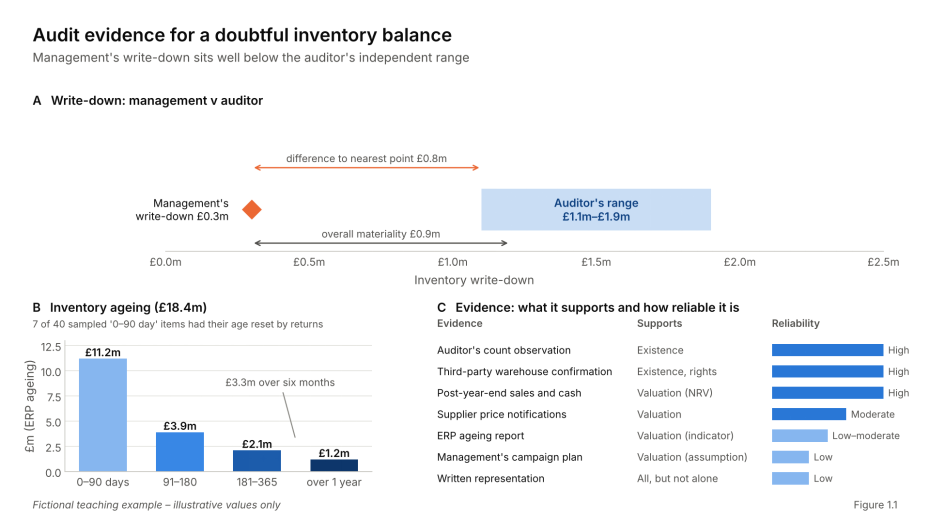
Figure 1.1. Fictional teaching example – illustrative values only. Audit evidence for a doubtful inventory balance. Management’s £0.3m write-down sits well below the auditor’s range of £1.1m to £1.9m, a difference close to overall materiality of £0.9m. Principal limitation: the conclusion is conditional on the evidence obtained and on whether management adjusts the write-down.
Common weaknesses in answers to this question
- Listing procedures without linking them to assertions. Credit comes from explaining which assertion each procedure addresses and why.
- Treating relevance and reliability as the same. The ageing report is relevant to valuation but unreliable if the system resets movement dates.
- Using count attendance as evidence of value. Existence and valuation require different evidence.
- Accepting management’s future plans as evidence. Plans are prospective and prepared by management; they need sceptical evaluation against the accounting framework and past experience.
- Treating written representations as sufficient. They are necessary but cannot substitute for other evidence.
References Audit Evidence for a Doubtful Inventory Balance
Financial Reporting Council (2022) International Standard on Auditing (UK) 500: Audit evidence (Updated May 2022). London: FRC. Available at: https://www.frc.org.uk/library/standards-codes-policy/audit-assurance-and-ethics/auditing-standards/isa-uk-500/ (Accessed: 18 November 2026).
Financial Reporting Council (2025) International Standard on Auditing (UK) 501: Audit evidence – specific considerations for selected items (Updated September 2025). London: FRC. Available at: https://www.frc.org.uk/library/standards-codes-policy/audit-assurance-and-ethics/auditing-standards/isa-uk-501/ (Accessed: 18 November 2026).
Financial Reporting Council (2026) International Standard on Auditing (UK) 240 (Revised March 2026): The auditor’s responsibilities relating to fraud in an audit of financial statements. London: FRC.
Financial Reporting Council (n.d.) International Standards on Auditing (UK), including ISA (UK) 200, ISA (UK) 450, ISA (UK) 540 (Revised December 2018), ISA (UK) 580 and ISA (UK) 705. London: FRC. Available at: https://www.frc.org.uk/library/standards-codes-policy/audit-assurance-and-ethics/auditing-standards/ (Accessed: 18 November 2026).
Griffith, E.E., Hammersley, J.S. and Kadous, K. (2015) ‘Audits of complex estimates as verification of management numbers: how institutional pressures shape practice’, Contemporary Accounting Research, 32(3), pp. 833–863.
IAASB (2026a) Proposed revisions for Audit Evidence & Risk Response: ISA 330, ISA 500 & ISA 520. New York: International Auditing and Assurance Standards Board. Available at: https://www.iaasb.org/publications/proposed-revisions-audit-evidence-risk-response-isa-330-isa-500-isa-520 (Accessed: 18 November 2026).
IAASB (2026b) ‘Latest on our projects’. Available at: https://www.iaasb.org/latest-our-projects (Accessed: 18 November 2026).
International Accounting Standards Board (2003) IAS 2 Inventories and IAS 10 Events after the Reporting Period. London: IFRS Foundation.
Nelson, M.W. (2009) ‘A model and literature review of professional skepticism in auditing’, Auditing: A Journal of Practice & Theory, 28(2), pp. 1–34.