Author: Elite
-

The examinable question Case brief. You are the audit senior on the audit of a UK electronics distributor for the year ended 30 September 2026. Inventory at year end is £18.4m (up from £12.1m the previous year) and cost of sales has only increased from £75m to £81m. Overall materiality is £0.9m. The product mix…
-

Case brief: A public sector service (260 staff across 5 regional teams) is in the process of replacing 3 disparate case management systems with a single cloud based platform. The programme board have approved the technology, the supplier contract and the go-live date (9 months away). The board’s readiness report currently tracks just one metric:…
-

The examinable question Case brief. A 900-person professional-services employer recruited heavily between 2021 and 2024, advertising roles as “hybrid, with flexibility to choose where you work”. Most employees settled into a pattern of one or two office days a week. In 2026 the executive team announced a minimum of three office days a week, citing collaboration,…
-

Case brief:A 420 person logistics business is planning to introduce automated stock picking at its main DC in 18 months time. The exec team have asked the people function to approve 60 further hires to “support the automation programme”. The people function are of the view that the bottleneck is not necessarily headcount. The existing records…
-

A robust literature review argument in the humanities presents the scholarly conversation (who says what and why), identifies and maps the positions and tensions within that conversation, and then uses interpretative synthesis to show how a proposed research project offers a new, defensible contribution. The argument is structured not as a catalogue of sources but…
-
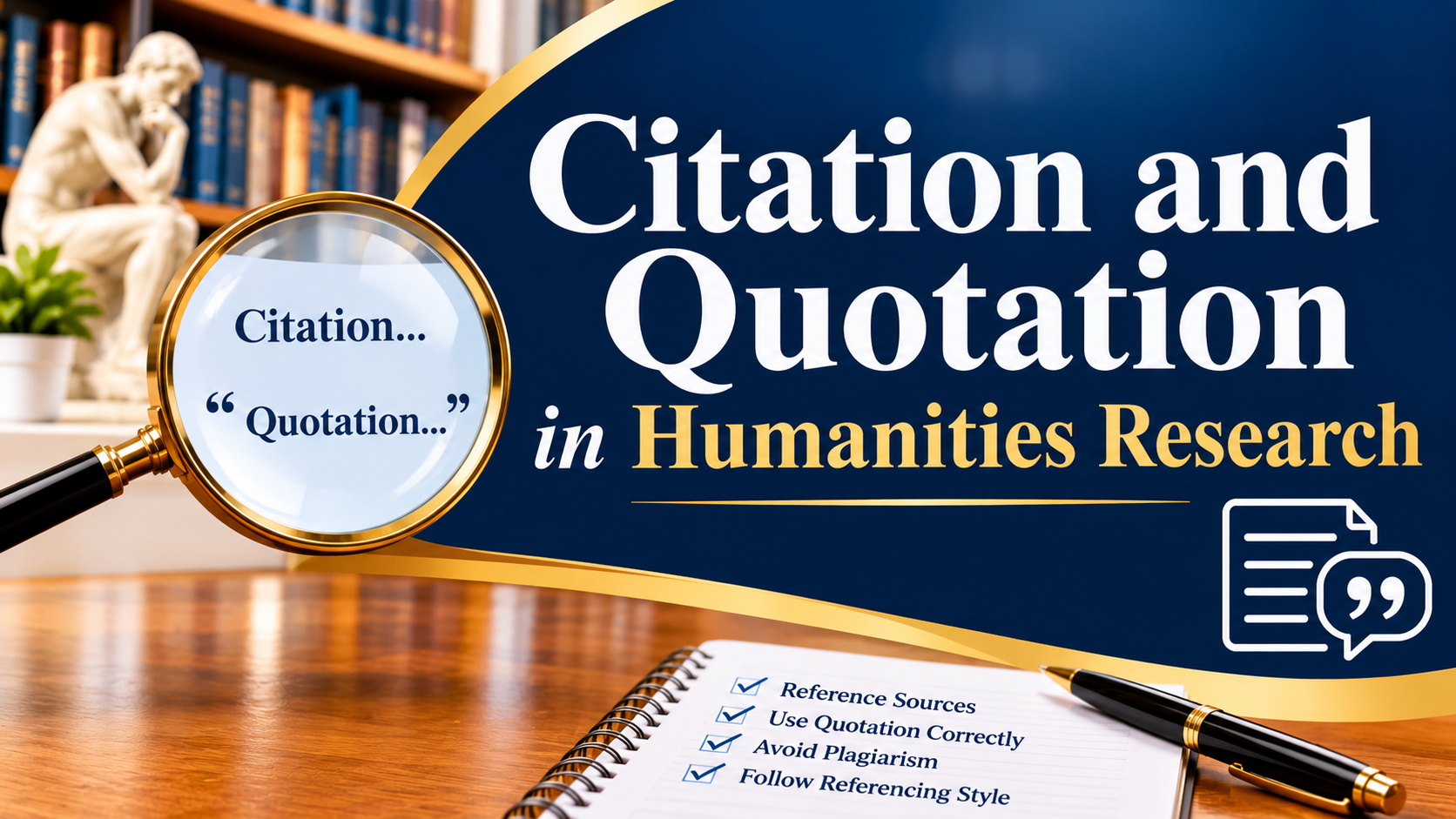
Citation and quotation in humanities research are tools for situating your argument within the scholarly conversation and for supporting close, text-focused claims. Use quotation to preserve the specific wording that matters to your claim; paraphrase to condense or reframe text where surface wording is not central; and always cite with enough detail (author, year, edition…
-

Comparing literary texts requires a clear comparative lens, a definable shared problem or theme, and an argument that foregrounds meaningful difference rather than mere similarity. A successful comparative claim pairs each interpretive assertion about one text with directly comparable evidence from the other; it organises evidence so that the relationship between texts illuminates an interpretive…
-

Close reading in literature is a disciplined method of attending to language, structure, pattern and context so that specific textual details become evidence for an interpretive argument. It is not plot summary. Instead, it moves from carefully observed features (diction, syntax, sound, imagery, form and structural choices) to claims about meaning, effect and significance, always…
-
Using Using Critical Theory Responsibly in Literary Analysis works best when theory functions as a question-raising lens rather than a preformed label. Responsible practice demands textual accountability (clear, traceable evidence in the text), historical sensitivity (recognising what a theory can and cannot tell you about a text produced in another time), and methodological reflexivity (acknowledging…
-
A literature search strategy is a planned, transparent series of decisions and actions that find, select, appraise and record the evidence needed to answer a specific question. It requires (1) a clear question and scope, (2) selection of appropriate databases and other sources, (3) translation of the question into keywords and controlled vocabulary, (4) search…
-
A robust Building a Literature Review Argument in the Humanities presents the scholarly conversation (who says what and why), identifies and maps the positions and tensions within that conversation, and then uses interpretative synthesis to show how a proposed research project offers a new, defensible contribution. The argument is structured not as a catalogue of…
-
Writing Analytical Paragraphs about Literature is a compact, coherent argumentative unit that advances an interpretive claim about a text by (1) stating a focused claim, (2) supplying precise textual evidence, (3) offering interpretation that explains how the evidence supports the claim, and (4) connecting that interpretation back to a wider argument or context. Its purpose…
-
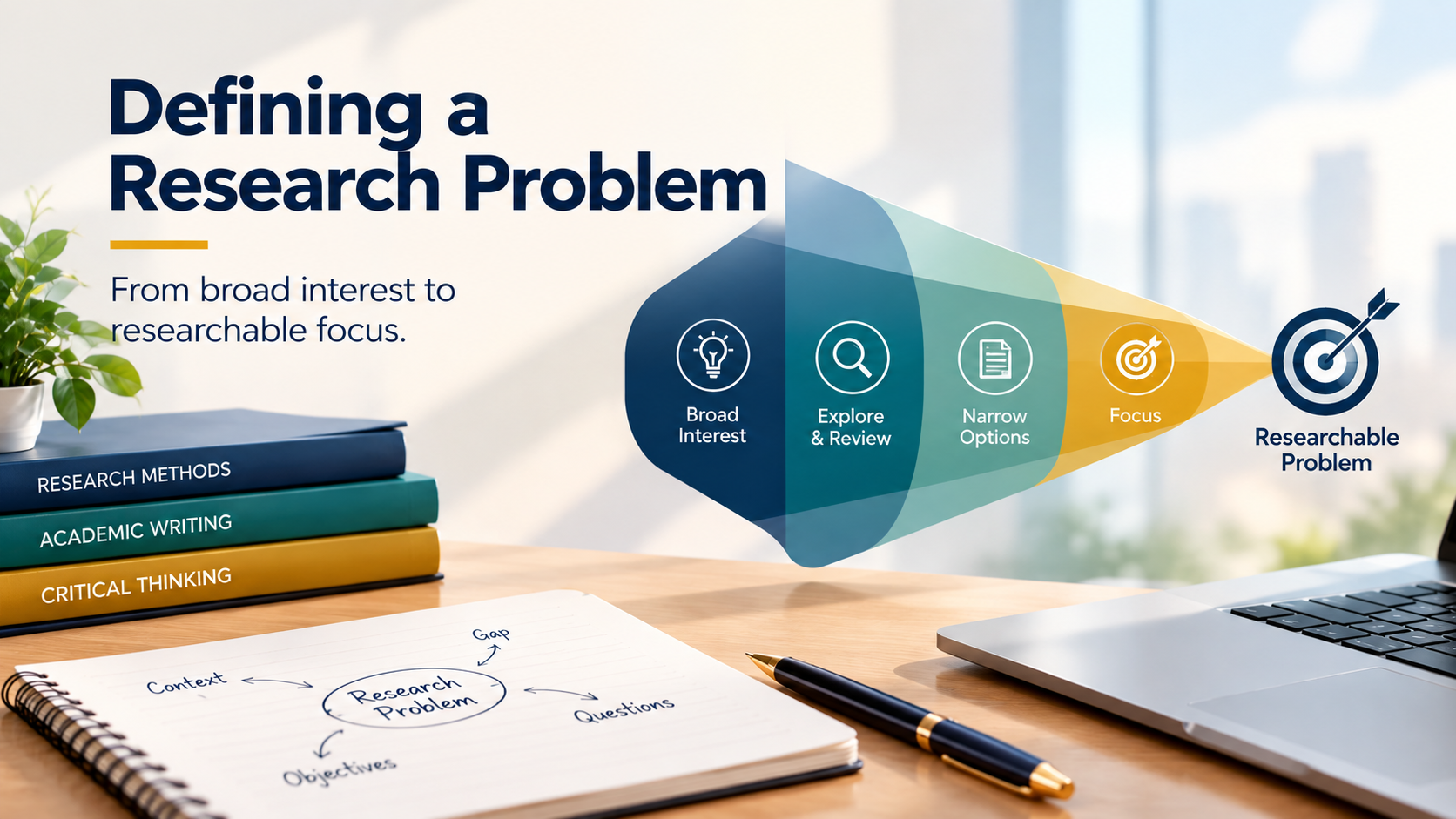
Defining a research problem means converting a broad interest area into a concise, evidence‑based statement that identifies an issue, situates it within context, evidences a gap or uncertainty, and specifies the purpose and feasible scope of enquiry. A well‑defined research problem is not a research question or hypothesis but the foundation that justifies and shapes…
-

Writing a critical discussion means turning your study’s findings into a defensible answer to the research question by integrating them with prior literature, testing alternative explanations, stating the precise scope of the contribution, acknowledging limitations without evasion, and drawing proportionate theoretical, practical and methodological implications that credibly motivate future enquiry (USC Libraries, 2026; University of…
-
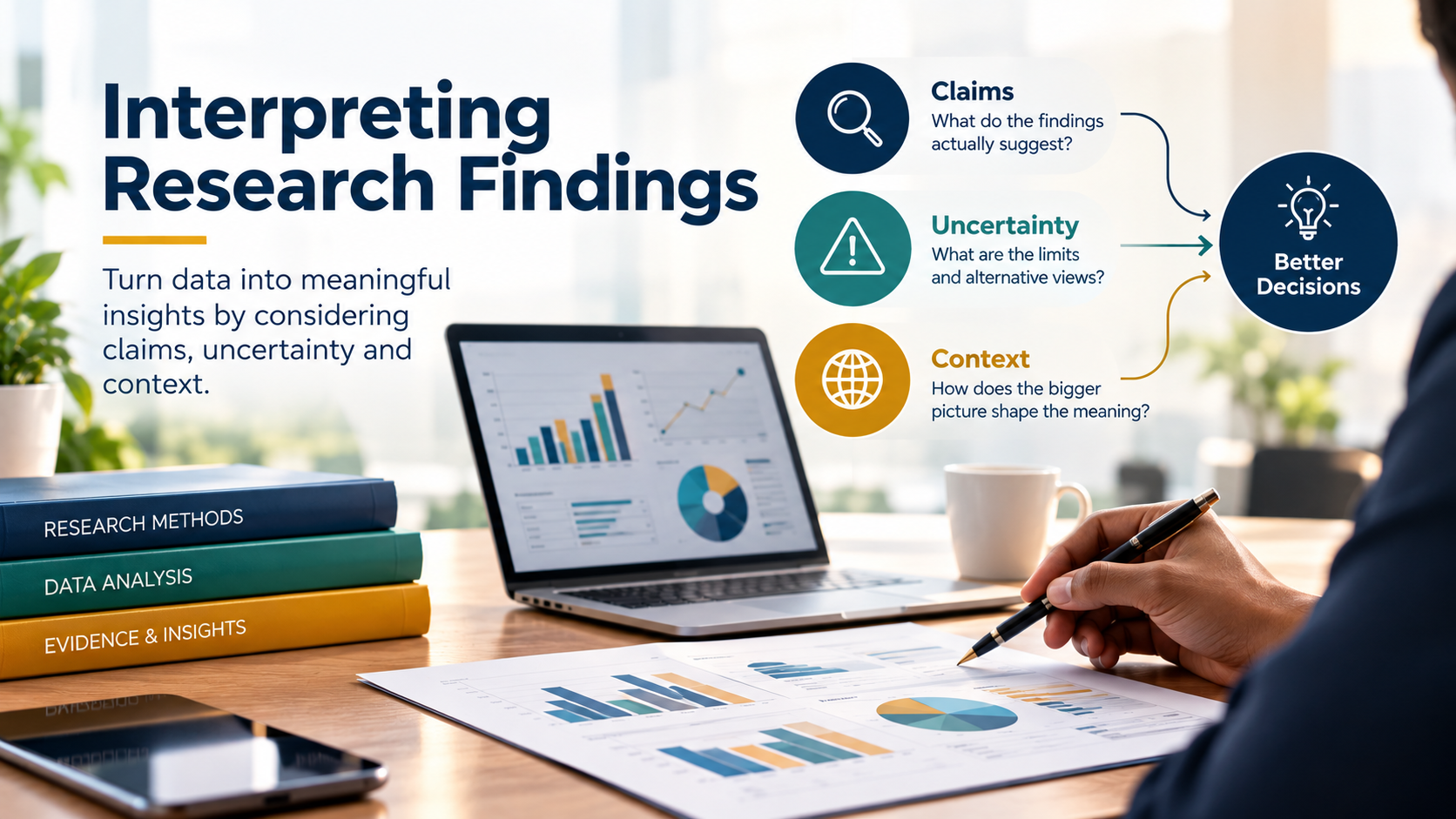
Interpreting research findings means clearly separating what was found (results) from what those patterns most plausibly mean (interpretations) and what might be done or inferred next (implications). Robust interpretation quantifies uncertainty, avoids inflating association into causation, appraises qualitative themes through context, reflexivity and transferability, and integrates different kinds of evidence into claims that are proportionate…
-

Research ethics and informed consent require proportionate, transparent, and participant-centred planning: provide clear information, support voluntary choices, protect privacy with honest limits, design data practices that match what you promise, and seek institutional ethics review before any live work (UK Research and Innovation, 2026a; UK Research and Innovation, 2026b; University of Oxford, 2026). Why ethics…
-
Choosing between Qualitative versus Quantitative Research Design depends first on the research question and the type of inference you intend to make. Use quantitative design where you seek measurement, comparison, or generalisable inference based on structured data and statistical models; use qualitative design where you seek in-depth understanding of meanings, processes, contexts or perspectives that…
-
Use a table when readers must look up exact values or compare many categorical items precisely; choose a chart when you want to reveal patterns—such as ordering, changes over time, distributions, or relationships—at a glance; add a figure (a composite of visuals, annotations and narrative) when interpretation benefits from contextual notes, model diagrams or multi-panel…
-
Sampling in research is the systematic process of defining the group of interest (population), specifying the accessible subset that can be contacted or observed (sampling frame), selecting an approach for choosing units from that frame (sampling strategy), and understanding what those choices allow or limit (bias, precision, and transferability). Good sampling aligns the research question…
-
Financial Ratio Analysis are structured comparisons that can reveal trends, relationships and questions for further investigation. They are not standalone verdicts on performance, value, solvency or management quality. Meaning depends on definitions, accounting policies, business model, period, benchmark and data quality. The analytical problem Profitability, liquidity, efficiency and leverage; trend and peer comparison; accounting-policy effects;…
-
Audit Evidence and Professional Judgement should be sufficient and appropriate for the assessed risk and purpose of an audit procedure. Professional judgement is not an unsupported preference: it is reasoned, documented and open to challenge. Reasonable assurance is not certainty. The analytical problem Evidence purpose, relevance and reliability; risk response; professional scepticism; documentation. This resource…
-
Data analytics in Modern Auditing can improve risk assessment, population understanding and focused testing, but analytics does not remove the need to assess relevance, reliability, bias, completeness, exceptions and professional judgement. Technology supports, rather than replaces, reasonable assurance. The analytical problem Purpose and risk response; data provenance and completeness; exceptions and corroboration; documentation and human…
-
Sustainability Reporting and Accounting Information can provide decision-useful information about risks and opportunities that may affect an entity’s prospects, but usefulness depends on materiality, governance, methods, boundaries, connectivity with financial reporting and transparent uncertainty. Reporting standards and jurisdictional adoption should not be conflated. The analytical problem Decision usefulness and materiality; governance and strategy; metrics and…
-
Forensic Accounting in the Digital Era combines accounting knowledge, investigation discipline, evidence handling and communication in matters where financial information may be disputed or irregular. Digital tools can extend review and pattern detection, but alerts are not proof of fraud and real cases require lawful authority, governance and qualified investigation. The analytical problem Fraud risk…
-
International standards can improve the common language of reporting, but comparability remains conditional on interpretation, estimates, enforcement, local law, business models, currency and disclosure quality. Comparable presentation is not identical economic reality. The analytical problem Common standards and reporting language; estimates and judgement; enforcement and local context; analytical comparison. This resource therefore distinguishes a calculation,…
-
An effective map communicates a specific geographic message to a stated audience. Layout, visual hierarchy, projection, scale, classification, symbols, labels and explanatory text should serve that message. Accessible cartography uses adequate contrast, avoids colour as the sole distinction, tests colour-vision-deficiency views and provides descriptive alternatives where a map cannot be read visually. What this decision…
-
Useful GIS Project Ideas Using Public Data connects a narrow geographic question, an available and permitted data source, an appropriate spatial method and a cautious claim. Begin with what can be represented and evaluated ethically; do not start with a spectacular map or a tool. Public data can support valuable projects when scope, metadata, licence,…
-
Georeferencing in ArcGIS aligns a raster such as a scanned map or image to a defined coordinate reference using identifiable control-point pairs and a transformation. Accuracy depends on the source raster, reference data, control-point quality and distribution, transformation and visual checks; a low RMS error alone does not prove accurate registration. What this decision is…
-
Buffer Analysis in ArcGIS creates polygons representing a stated distance around features. It is useful for a clearly defined proximity question, but a buffer is not automatic evidence of access, exposure, service use, risk or causation. Distance, units, coordinate reference system, planar or geodesic method, dissolve choice and overlay logic all affect meaning. What this…
-
Vector versus Raster Data in GIS are two ways of representing geographic phenomena. Vector uses points, lines and polygons with attributes; raster uses a grid of cells with values. Choose the model that fits the phenomenon, measurement, scale, resolution and proposed operation, rather than treating either model as universally superior. What this decision is really…